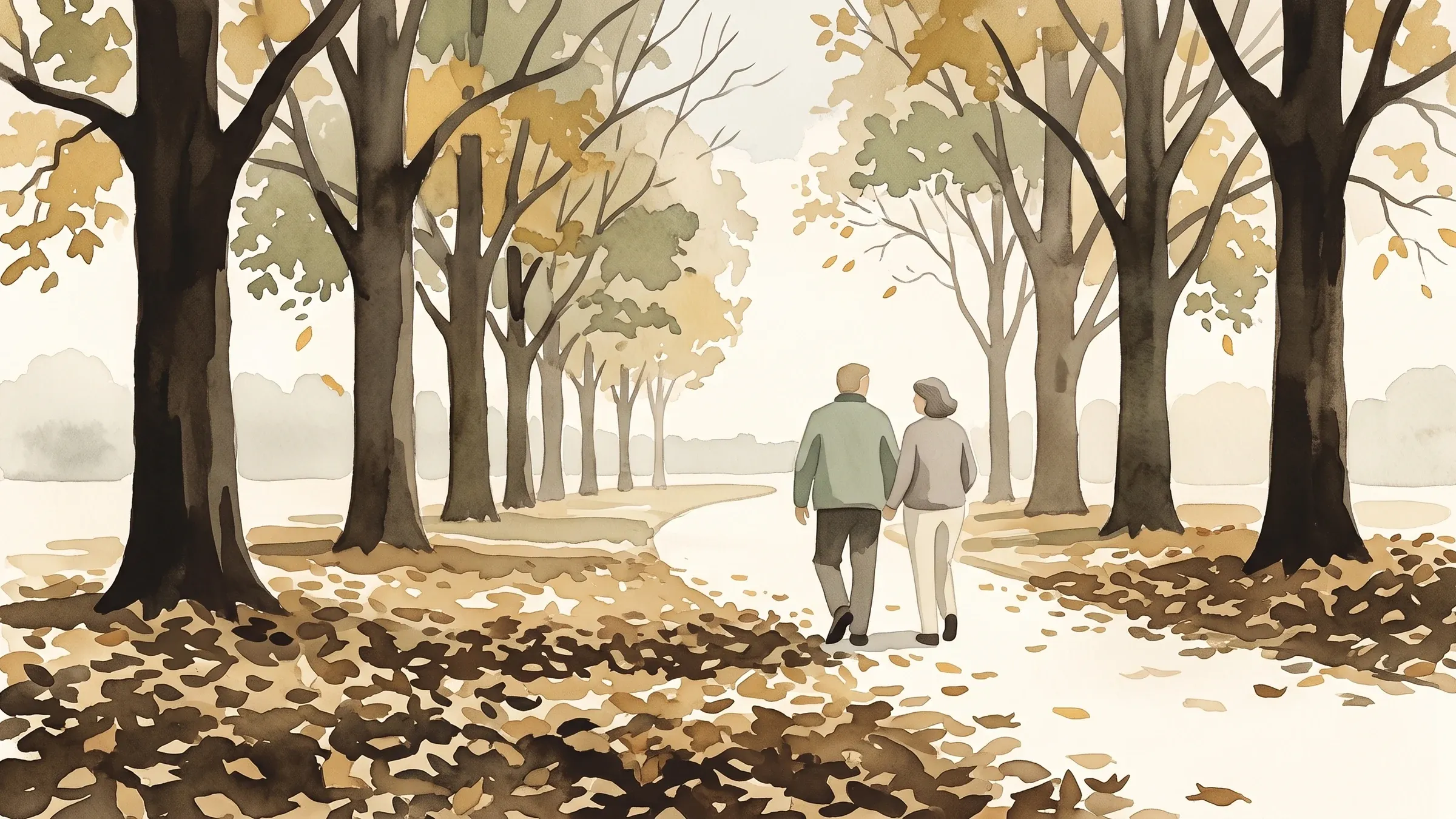
Couples who exercise together report higher relationship satisfaction, better mood, and stick with the habit nearly twice as long as people who go it alone. A walking challenge turns the simplest shared activity into a daily reason to connect. No gym, no gear, no competition required.
Yet only about one-third of couples exercise together in a given week, according to a PMC study on joint health behaviors. That’s a missed opportunity. Walking is the lowest-barrier entry point to moving together, and a challenge gives it structure without making it feel like a chore.
This guide covers the research on why walking challenge ideas for couples actually strengthen relationships, 10 specific challenges you can start this week, how to set one up in 10 minutes, and what to do when motivation dips. If you’re looking for a broader overview of social walking, start with our complete guide to walking with friends.
Why is a walking challenge the best couples fitness habit?
Walking together combines three relationship-strengthening mechanisms: behavioral synchrony, side-by-side conversation, and shared novel experiences. It requires zero fitness experience, zero equipment, and as little as 20 minutes a day.
What does the research say about couples who exercise together?
Couples who exercise together are more likely to stay together and stay active. The data points to relationship quality, not just physical health.
Sackett-Fox et al. (2021) found that both partners reported higher positive affect and relationship satisfaction on days they exercised together. The effect held even after controlling for individual exercise. Aron et al. (2000) found that couples who regularly share novel activities report higher relationship quality. A walking challenge with creative variations qualifies as exactly this kind of shared novelty.
A Kansas State University study found that a partner’s presence increases exercise effort by up to 200%. And according to a Hanson & Jones systematic review of 42 studies, people who walk in groups maintain 75% adherence over time, far higher than solo walking typically manages.
Oxford University research on behavioral synchrony shows that moving in rhythm with another person increases cooperation, trust, and bonding. About 50% of couples synchronize their steps without trying.
Why walking specifically, and not running or the gym?
Walking is the only exercise accessible to virtually every couple, at every fitness level, at every age, and it creates the conditions for emotional connection that higher-intensity workouts don’t.
Here’s why walking works better for couples than most other exercise:
- Side-by-side conversation. Sociologist Harry Brod found that men define emotional closeness as “working or playing side by side,” not face to face. Walking is the perfect format for this.
- Lowest barrier to entry. No skill, no equipment, no membership. Just a door.
- Cortisol drops fast. Stanford Lifestyle Medicine research shows 20 to 30 minutes of walking drops cortisol at the highest rate of any low-intensity exercise. The research on walking for mental health shows these benefits are even stronger when you walk with someone you care about.
- Pace-matching is natural. Purdue University research found that couples naturally match the slower partner’s pace when walking together.
- Flexible enough for any couple. A walk can be a date, a decompression ritual after work, or a challenge. It fits wherever you need it.
For more on the science behind social walking, see benefits of walking with friends.
What are the 10 best walking challenge ideas for couples?
These challenges work whether you live together or across the country, whether you walk 3,000 steps or 13,000. Each one adds a layer of fun, connection, or exploration to the simplest activity two people can share. (If you’re still picking the app to run them in, the walking app for couples guide covers same-home, long-distance, and cross-platform picks before you commit.)
1. The 30-day “walk and talk” challenge
Commit to one 20-minute walk together every day for 30 days. No phones, no headphones. Just conversation.
To make it more interesting, each person brings one question to every walk. You can use a conversation card deck or just ask something you’ve been curious about. One couple I know started this after their second kid was born and said it was the first time in months they’d had an uninterrupted conversation. They’re still doing it a year later.
Why it works: It builds the ritual. Protected couple time becomes a habit, not a scheduling negotiation. Your partner becomes your walking accountability partner without either of you needing to play coach.
2. The “walk to somewhere” virtual distance challenge
Pick a meaningful destination: the city where you met, your honeymoon spot, your parents’ hometown. Track your combined daily steps and map the progress toward that destination.
New York to Chicago, for example, is roughly 1.2 million combined steps, about six weeks at 15,000 combined steps per day. Track with a virtual challenge platform, a spreadsheet, or Steps Club where you both see each other’s daily totals.
Why it works: A shared destination gives abstract step counts a story.
3. The sunset (or sunrise) walk streak
Walk during golden hour every day for two weeks. Take a photo together at the same spot each time.
By the end, you’ll have a visual time-lapse of your streak. One couple posted theirs on Instagram and it quietly became one of those “relationship goals” posts, not because it was staged, but because 14 days of showing up together at the same bench is genuinely hard to fake.
Why it works: It ties the habit to a specific time and creates a visual record that feels rewarding to look back on.
4. The neighborhood explorer challenge
Walk every street in your neighborhood or zip code. Print a map (or download one) and highlight completed streets after each walk.
You’ll discover things you never noticed: a hidden park, a bakery, a house with an absurdly elaborate garden. The map filling in over time is surprisingly satisfying.
Why it works: It gamifies exploration without creating competition between you. Same team, same map.
5. The “steps date” challenge
Replace one sit-down date per week with a walking date. Rotate themes: a food walk where you visit three different spots, a museum walk, a nature walk, a night walk through a part of town you’ve never explored.
Walking dates tend to be cheaper than restaurant dates and more memorable.
Why it works: It solves the “what should we do tonight” problem and builds walking into your relationship rhythm.
6. The personal-best (not partner-best) challenge
Each person sets their own step goal based on their own baseline. You celebrate when either partner hits their goal. No comparison, no shared target, no “you only walked 5,000 and I walked 12,000.”
This is how Steps Club works: individual goals, shared celebration. Your 5,000-step day is just as valid as your partner’s 12,000-step day. Both get a celebration in the activity feed.
Why it works: It removes the biggest friction point in couples fitness: feeling like you’re slowing someone down or being held back.
7. The podcast or audiobook walk challenge
Pick a podcast series or audiobook together. The rule: you can only listen while walking together.
This creates anticipation. Want to find out what happens next? Time to walk. One couple I talked to binged an entire true-crime series this way and said they walked more in that month than they had in the previous six combined.
Why it works: It pairs something you already want to do (listen) with something you want to do more of (walk). Habit stacking at its simplest. Or try the opposite approach: a silent walking challenge where you ditch the headphones entirely and just talk to each other.
8. The walking scavenger hunt
Create a list of 25 to 50 things to spot over a month. Categories might include nature (a red bird, three types of flowers, a tree taller than a building), architecture (a blue door, a round window, a house with a wraparound porch), and people (someone walking a dog bigger than them, a runner in costume).
Check items off together. This works especially well as a seasonal challenge: spring flowers in April (pair it with our 30-day spring walking challenge so the scavenger hunt overlaps with a structured step plan), holiday decorations in December.
Why it works: It gives you something to look for, which makes you look up from the sidewalk.
9. The “walk and surprise” challenge
Alternate who plans the route each walk. The planner picks a new path, a detour, a coffee stop, a scenic viewpoint, or a place neither of you has been.
The key is small surprises. Just “I found a path along the creek we’ve never taken” or “there’s a taco truck three blocks over.” Aron’s research on shared novel experiences directly supports this: even small novelty strengthens relationship quality.
Why it works: It keeps walks unpredictable. You stop defaulting to the same loop around the block.
10. The long-distance “walk with me” challenge
For couples who don’t live together, travel frequently, or are in long-distance relationships. Walk at the same time on FaceTime or a phone call. Share what you’re seeing. Send each other a photo from your walk every day.
Track your steps in a shared app. In Steps Club, you can create a private club of two and see each other’s steps update throughout the day. Start a live walking session and you’ll both know the other person is out there, even from 1,000 miles away. If this is your default setup, our guide to the best walk together app for couples apart walks through the category and picks beyond Steps Club.
Why it works: Distance makes shared routines harder, but not impossible. A daily walk at the same time creates a touchpoint that feels like being together.
If you have kids and want to involve the whole household, a family step challenge uses the same personal-goal approach with age-appropriate targets for every generation.
If you want even more ideas for walking with a group, see how to start a step challenge with friends.
How do you set up a couples walking challenge?
Pick your challenge, agree on individual goals, choose a tracking method, set a start date, and build in a small reward for finishing. The whole setup takes 10 minutes.
Step 1: Choose your challenge (and start easier than you think)
Pick one idea from the list above. If you’ve never walked together regularly, start with 7 days, not 30. The goal is to finish the challenge, not to be heroic about it. You can always extend.
Step 2: Set individual goals, not shared ones
Different schedules, fitness levels, and energy on any given day mean a shared step target will frustrate one of you. “We both hit our own goal today” is a better metric than “we walked the same number of steps.”
This prevents the slower partner from feeling like a bottleneck. It also prevents the faster partner from feeling held back. Individual goals, shared celebration.
Step 3: Pick a tracking method
- Simple: Apple Health or Google Fit (already on your phone)
- Social: Steps Club (private club of two, see each other’s steps, live walking sessions)
- Virtual distance: The Conqueror or Run the Edge (map-based progress)
- Analog: A wall calendar with check marks
If you want to compare options in detail, see our guide to the best walking apps for groups.
Step 4: Agree on the rules (and the escape clause)
Decide what counts. Only walks together, or all daily steps? What happens if someone misses a day? The right answer: nothing. No guilt, no penalty. Build in a “life happens” clause. Two skip days per 30-day challenge is reasonable.
Step 5: Pick a finish-line reward
A dinner at a favorite restaurant. A weekend trip to the place you “virtually walked to.” New walking shoes. Or just the satisfaction of keeping the habit, which is the real reward.
What’s the best app for a couples walking challenge?
The best app depends on what you want: Steps Club for private, non-competitive step sharing between two people; StepUp or Stridekick for leaderboard-style competition; or The Conqueror for virtual distance challenges with real medals.
What to look for in a couples walking app
Not every walking app is built for two people. What matters:
- Privacy: Just the two of you, or a public profile?
- Connection vs. competition: Leaderboards, or celebration?
- Cross-device: Does it sync with both your wearables?
- Simplicity: Will you both actually open it?
How Steps Club works for couples
Steps Club was built for exactly this kind of small, private group. Create a private club of two. Each person sets their own daily step goal. You see each other’s steps in the activity feed throughout the day. Start a live walking session to walk together even from different locations. Tap a heart when your partner hits their goal.
There’s no leaderboard, no ranking, no public profile. Just two people who want to walk more and want to see each other doing it. Download Steps Club and set up your club in about 30 seconds.
Other apps worth considering
- StepUp: Good if you both want head-to-head competition with leaderboards and rankings
- The Conqueror: Virtual distance challenges with physical medals mailed to you
- Stridekick: Originally built for workplace challenges, adapted for small groups
Each has strengths. Steps Club is the best fit if you want something private, gentle, and designed for connection over competition.
How do you keep a couples walking challenge going when motivation dips?
Lower the bar on hard days (a 10-minute walk still counts), let each person set their own pace, never guilt your partner for missing a day, and remember that the conversation matters more than the step count.
What if your partner walks faster (or slower) than you?
Walk together at the slower pace. The point is connection, not cardio. Purdue University research found that couples naturally match the slower partner’s pace when walking together, and that’s a feature, not a bug.
If one partner wants intensity, add a solo fast-walk or run on top of the shared couple walk. The couple walk stays at the pace where you can both talk comfortably. For gentle variations that work at any pace, explore tai chi walking.
What if one of you loses motivation?
Try the 5-minute rule: agree to walk for just 5 minutes, then decide whether to keep going. Most of the time, you’ll keep going. The hardest part of any walk is the first 30 seconds.
Switch challenge types if the current one feels stale. Move from the 30-day walk-and-talk to a scavenger hunt or a virtual distance challenge. Variety prevents burnout.
And revisit why you started. If the goal was connection, a 10-minute walk where you actually talk is worth more than a 45-minute power walk in silence. For more on this, see how to motivate friends to walk more.
Start your couples walking challenge today
You don’t need a plan. You don’t need gear. You don’t need to be “fitness people.” You need a door, a partner, and 20 minutes.
Pick one challenge from this list. Start with 7 days. Set your own step goals. And pay attention to what happens when you’re walking side by side with the person you care about most. The step count is never the point. The conversation is.
If you want a simple way to see each other’s steps and celebrate when you both hit your goals, download Steps Club. Create a private club of two. It’s free, it takes 30 seconds, and it turns “we should walk more” into something you actually do.