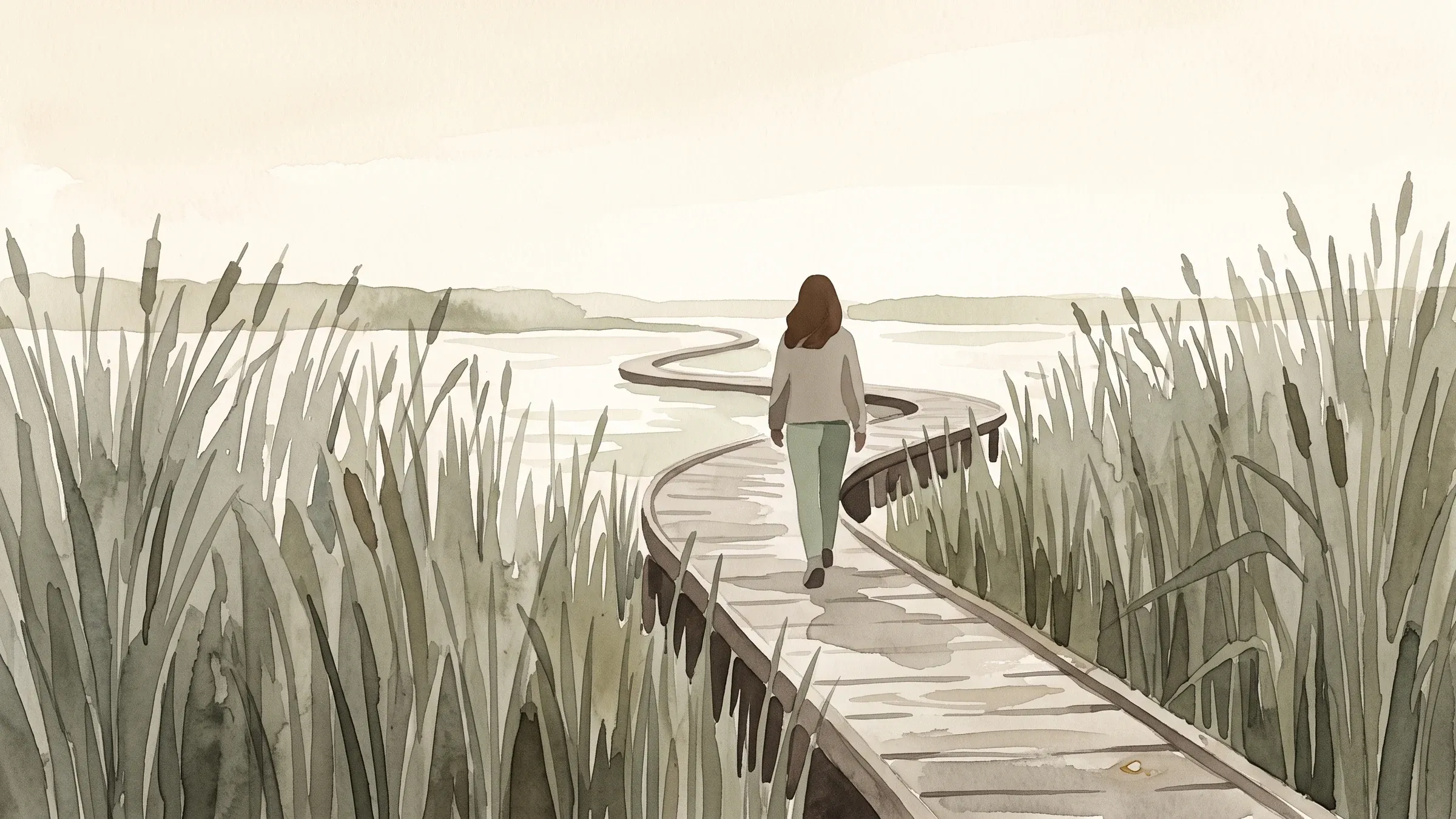
Walking without headphones shouldn’t feel radical. But for a generation averaging nearly eight hours of daily screen time, putting the phone away and walking in silence has become one of the most talked-about wellness trends on TikTok.
The trend has a name: silent walking. It started with a single TikTok in 2023, racked up hundreds of thousands of views, sparked debate across every major health publication, and quietly changed the habits of people who tried it on a whim and never went back.
Here’s what silent walking actually is, what the research says about why it works, and a perspective the internet keeps missing: silent walking with someone you trust might be the original, and most powerful, version of this practice.
If you’re someone who already walks with friends or wants to start, this connects directly to the science behind walking with friends and the broader idea that walking is better when it’s shared. You can download Steps Club to try it with your people.
What is silent walking?
Silent walking is the practice of walking without music, podcasts, phone calls, or any audio distraction. You walk, and you let the world around you be the only soundtrack.
The term was popularized by TikTok creator Mady Maio in June 2023. Her boyfriend challenged her to walk without her AirPods for once. She tried it, found it surprisingly difficult, then found it surprisingly transformative. The video earned roughly 486,000 views and launched a trend that outlasted the typical TikTok cycle.
But Mady Maio didn’t invent this practice. She named something humans have done for thousands of years. Vietnamese Buddhist monk Thich Nhat Hanh taught walking meditation as a core practice for decades, writing, “Take my hand. We will walk. We will only walk.” His version was never solo. It was communal, shared, and silent by design.
The distinction between silent walking and mindful walking is worth noting. Silent walking removes the external noise: no earbuds, no phone audio. Mindful walking is the internal practice: paying attention to your breath, your feet on the ground, the sounds around you. Silence makes mindfulness easier, but they’re not the same thing. You can walk silently while your mind races, and you can walk mindfully with a podcast paused. The sweet spot is both at once.
Why is walking in silence good for your brain?
Silent walking reduces repetitive negative thinking, boosts creative output, and activates the brain’s rest-and-reflect network within minutes. The research behind these effects is stronger than you’d expect for something so simple.
Does silence reduce rumination and negative self-talk?
A 90-minute nature walk reduces rumination and decreases activity in the subgenual prefrontal cortex, the brain region linked to depression risk, according to a 2015 Stanford study published in the Proceedings of the National Academy of Sciences.
Gregory Bratman’s team scanned participants’ brains before and after walking. Those who walked in a natural setting showed measurable decreases in the part of the brain that drives repetitive, self-critical thoughts. The control group, who walked along a busy road, showed no change.
Rachel, a 28-year-old graphic designer in Portland, started silent walking after a rough breakup in 2024. “I used to fill every walk with podcasts because I was scared of what my brain would do in the quiet,” she said. “The first week was brutal. By the third week, the quiet was the whole point. My therapist noticed before I did.”
Silent walking doesn’t suppress anxious thoughts. It gives the brain room to process them and move on, rather than replaying them on a loop. For a deeper look at the research connecting movement and mood, see our guide on walking for mental health.
Can walking without headphones make you more creative?
Walking increases creative output by 60% compared to sitting, according to a Stanford study published in the Journal of Experimental Psychology. The study tested 176 participants on divergent thinking tasks, and the walkers consistently outperformed.
The researchers, Marily Oppezzo and Daniel Schwartz, found that the creative boost happened whether people walked on a treadmill or outside. The key factor was movement, not scenery. Removing audio distractions likely amplifies this. When you walk without input, your brain activates the default mode network, the neural pathway responsible for “shower thoughts” and connecting ideas that seem unrelated.
Marcus, a freelance writer in Chicago, now takes a 20-minute silent walk before every writing session. “I used to think I needed music to get in the zone,” he told me. “Now I need the opposite. The ideas don’t come when I’m being fed content. They come when my brain has nothing to do but wander.”
Does even a short period of silence change your body?
Two minutes of silence lowers heart rate and blood pressure more effectively than slow, relaxing music. That finding comes from a 2006 study published in Heart, a BMJ journal.
The researchers were actually studying the effects of music on the cardiovascular system. The surprise was that the two-minute pauses of silence between musical tracks produced the most significant relaxation response. Silence activated the parasympathetic nervous system, the body’s “rest and digest” mode, more powerfully than the music itself.
This means you don’t need a 90-minute nature walk to feel something. Even a short silent walk around the block shifts your nervous system. The bar is genuinely low.
Can silence grow new brain cells?
A 2013 study published in Brain Structure and Function found that mice exposed to two hours of silence developed new cells in the hippocampus, the brain region associated with memory and emotion. This process, called neurogenesis, was more pronounced with silence than with any auditory stimulus tested, including music and ambient noise.
This is an animal study, so the translation to humans is uncertain. But the finding fits a larger pattern: silence isn’t just the absence of sound. It’s an active state that gives the brain room to repair and reorganize.
What are the other benefits of silent walking?
Beyond brain health, silent walking reduces stress hormones, improves environmental awareness, and serves as a sustainable form of digital detox. A 2022 meta-analysis published in Science synthesized more than 300 studies across 61 nations and found that nature interaction enriches human wellbeing in over 200 non-material ways.
Stress and cortisol reduction. A 2022 study found that a one-hour nature walk reduced stress-related brain activity and restored focused attention. The effect was strongest when participants walked without technology.
Better environmental awareness. Walking without headphones means you hear your surroundings: traffic, cyclists, birds, other people. It’s a safety benefit that rarely gets mentioned.
A digital detox that’s actually sustainable. Most digital detox advice asks you to change your entire relationship with technology. Silent walking asks you to put your phone in your pocket for 20 minutes. That’s a low enough bar that people actually stick with it.
Sleep quality. Combining physical activity with reduced screen stimulation before bed is one of the most effective sleep hygiene habits. A silent evening walk covers both.
How do you start silent walking?
Start with 10 minutes, leave your headphones at home, and let the first few walks feel uncomfortable. Most people find silence genuinely difficult before they find it genuinely restorative.
Step 1: Start with 10 minutes. Don’t overthink the duration. Ten minutes is enough to notice the difference. You can build from there.
Step 2: Leave your headphones at home. Not paused. Not in your bag. At home. The temptation to put them in is real, and having them available makes it too easy to give in three minutes into the walk. Tara, a 34-year-old teacher in Austin, told me she puts her AirPods in her kitchen drawer before her morning walk. “If they’re in my pocket, they’re in my ears by the second block.”
Step 3: Walk somewhere you enjoy, even if it’s not “nature.” Parks are great, but a quiet neighborhood street works fine. A busy downtown works too. The point isn’t scenery. It’s the absence of self-selected audio. Let the environment be whatever it is.
Step 4: Notice without narrating. Feel your feet on the ground. Hear the sounds around you. Notice the sky. You don’t need to meditate or breathe a certain way. Just walk and notice. If your mind wanders, let it. That’s the default mode network doing its job.
Step 5: Build to 20-30 minutes over two to three weeks. The research suggests that 20 minutes is where most of the cognitive and emotional benefits become pronounced. But even two minutes of silence changes your physiology. There’s no minimum that doesn’t count. Silent walking is also a perfect candidate for habit stacking — pair it with your morning coffee or your post-lunch routine and it becomes automatic.
What’s the part about silent walking that no one talks about?
Every top-ranking article on silent walking frames it as a solo activity. The most authoritative piece, from TODAY.com, literally instructs: “No phone, no walking buddy, no dog.” The research on shared silence says otherwise.
Healthline, Psychology Today, Marie Claire, Bustle, Fit&Well, MoveTogether: every single one defines silent walking as something you do alone. The assumption is that silence requires solitude. It doesn’t.
Netta Weinstein, a psychologist at the University of Reading, led a 2024 study on shared silence in close relationships. Across four studies and 587 participants, she found that intrinsic silence, the comfortable kind that happens naturally between people who trust each other, was associated with intimacy, peacefulness, autonomy, and relationship fulfillment. The positive feelings were specifically low-arousal: relaxed and peaceful, not excited or energized.
This is exactly what happens on a silent walk with a friend. You’re both present. Both undistracted. Both walking. The silence between you isn’t awkward. It’s the point.
Thich Nhat Hanh understood this decades before TikTok existed. His walking meditation was always communal. Hundreds of people walking in silence together, breathing together, present together. “Walk as if you are kissing the Earth with your feet,” he wrote. He never said you had to do it alone.
Elena and her college roommate Priya started doing Tuesday morning silent walks in January 2025. “The first time was weird,” Elena said. “We kept wanting to talk. By the third week, the quiet part became our favorite part. We’d walk 20 minutes in silence, then get coffee and have the best conversations. The silence somehow made the talking better.”
Walking in silence with someone you trust is not a compromise. It’s the original form of walking together, before headphones existed, before anyone needed a TikTok trend to put the phone away.
How do you try silent walking with a friend?
Agree on “phones away, no talking for the first 15 minutes,” walk side by side, and let conversation happen naturally after the silent stretch. According to the Weinstein study, comfortable shared silence produces stronger feelings of connection when it arises naturally rather than being forced indefinitely.
Here’s how to set it up:
Pick one person. Not a group of five. Silent walking with a crowd is walking meditation, which is beautiful, but a different thing. Start with one friend, your partner, or a family member you’re comfortable being quiet around.
Agree on the ground rules up front. “Let’s walk the first 15 minutes without talking or phones. After that, we talk if we want to.” Setting expectations prevents the “should I say something?” anxiety that kills it.
Walk side by side, not single file. Walking next to someone is an act of presence. You’re sharing the same view, the same sounds, the same pace. It feels different from walking behind someone.
Let conversation happen naturally after the silent stretch. Elena and Priya both noticed the same thing: the conversations after silent walking were different. More honest. More grounded. Less performative.
Use Steps Club to stay connected even when apart. Start a Live Walking Session so your friend sees you’re out there, even from another city. You’re walking in silence together without needing to be in the same place. You can start a private club for just the two of you: “Tuesday silent walks.” The accountability of knowing your friend is expecting you to walk is the gentlest motivation there is.
People who walk with others stick with the habit 75% of the time, far higher than solo walking typically manages. Silent walking is hard to sustain alone because there’s no external structure. A walking accountability partner who walks at the same time IS the structure.
If you’re looking for more ways to bring friends into your walking habit, our guide on how to motivate friends to walk more covers what to say, what not to say, and how to make the invitation feel like a gift rather than a lecture.
How does silent walking compare to other walking trends in 2026?
Silent walking is one of several walking trends gaining mainstream attention, each with a different focus: the Japanese walking method uses interval pacing for cardiovascular fitness, tai chi walking emphasizes slow, mindful heel-to-toe movement, and hot girl walks combine social empowerment with longer distances.
Silent walking’s niche is presence and digital detox. It’s the least physically demanding of the bunch, which is part of its appeal. If you want the opposite — maximum physical intensity from a walk — rucking adds a weighted pack for two to three times the calorie burn. You don’t need to learn a technique or change your pace. You just stop adding noise.
What all of these trends have in common is that they’re better with your people. The Japanese walking method is more fun as a walking-and-talking interval with a friend. Tai chi walking is the only practice slow enough to share with a parent or grandparent. And silent walking, as we’ve covered, has a dimension the internet keeps ignoring: the shared version.
46% of Gen Z reports actively limiting their screen time, according to 2025 data, while averaging 7 hours and 43 minutes of daily screen use. That tension between wanting less screen time and being unable to reduce it is exactly why silent walking resonates. It’s a 20-minute escape that requires zero willpower beyond leaving your AirPods behind.
For a full picture of how walking with friends fits into your life, check out our complete guide to walking with friends.
The quiet is the point
Silent walking is one of those trends that sounds like nothing but changes how your day feels. The research backs it up: less rumination, more creativity, lower heart rate, a calmer nervous system. All from doing less, not more.
Try it solo first if that’s more comfortable. Then try it with someone you trust. The silence between two people who care about each other isn’t empty. It’s full of something most apps will never track.
Steps Club won’t measure your mindfulness or grade your silence. That’s not the point. But it will show your friend that you’re out there walking, and they’ll show you the same. Sometimes that’s all the motivation you need.
Download Steps Club and start a silent walk with your people.