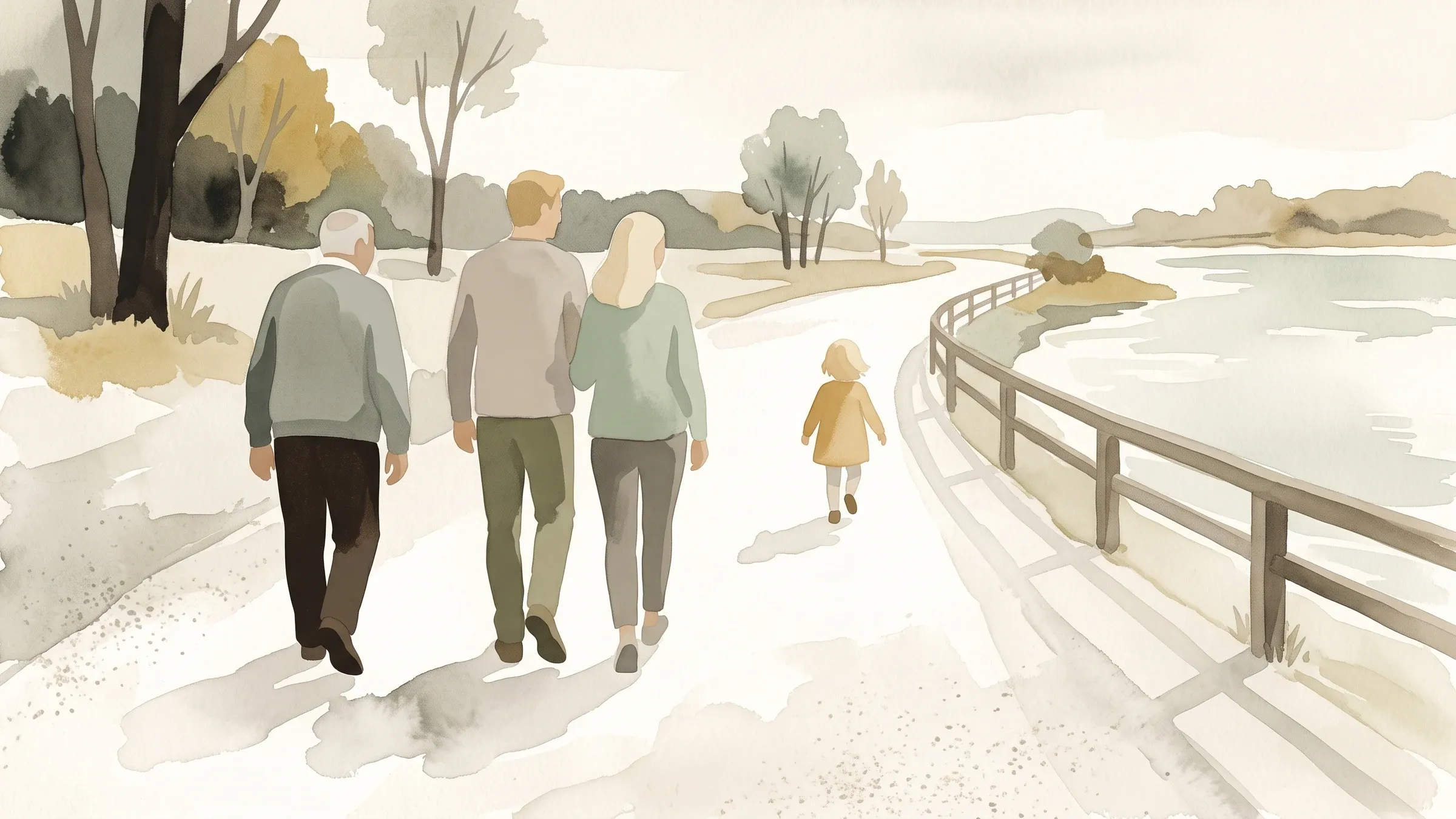
A family step challenge sounds simple until you realize grandma walks 4,000 steps on a good day and her teenage grandson clears 14,000 before lunch. Most step challenges treat everyone the same: one goal, one leaderboard, one winner. That works for an office of peers. It falls apart for a family that spans three generations.
The problem isn’t that some people walk less. It’s that most challenge apps declare those people the losers. A 75-year-old who walks twice as far as she did last month still finishes last on a leaderboard built for 25-year-olds. She stops checking the app. Then she stops walking.
There’s a better way. Let every family member set their own goal and celebrate when they clear it. A family exercise study found that families who exercise together report 65% higher happiness than people who exercise alone. The key is designing the challenge so everybody wins on their own terms.
This guide covers why family step challenges work, how to set one up fairly, age-appropriate step goals, ten creative challenge formats, the best tracking apps, and how to keep the whole family walking past week one. If you’re also interested in walking challenges with friends outside the family, check out our complete guide to walking with friends.
Why are families who walk together happier and healthier?
Family-based exercise produces 65% higher happiness scores and 83% greater vitality than exercising alone, according to a 2024 study of 110 participants. A family step challenge turns the simplest form of exercise into a shared daily habit that benefits every generation.
The research here is unusually strong. A Step it Up Family study in Queensland, Australia gave activity trackers to 40 entire families and tracked them through a step challenge program. Retention was 95%. Not 95% of individuals. Ninety-five percent of whole families stuck with it. When the whole household is involved, nobody gets left behind.
And the benefits compound across generations. According to the American College of Sports Medicine, children with two physically active parents are 5.88 times more likely to be active themselves. A family step challenge isn’t just about this month’s steps. It’s about building a culture of movement that kids carry into adulthood.
Walking has one more advantage over every other family exercise: you can talk while you do it. Penn State Extension’s research on multi-generational walking found that walking side-by-side opens communication channels that sitting face-to-face doesn’t. Kids share things on a walk they’d never say across a dinner table. Grandparents tell stories differently when their feet are moving. Research from the Yiriman Project in Australia found that intergenerational walking “allows young and elders to travel on a literal and symbolic journey.” That’s the real benefit, and it’s the reason walking is the most accessible form of social exercise.
There’s also the partner effect. People who exercise with a spouse or partner show 3.68 times higher walking adherence at six months compared to solo exercisers. If you and your partner want to start smaller before involving the whole family, a couples walking challenge is a great on-ramp. If two people sticking together triples the odds, imagine what an entire family does.
Sandra, a retired nurse in Portland, started a family step challenge last Thanksgiving with her two adult children and four grandchildren, ages 8 to 16. “The first week was chaos,” she said. “Everyone had different schedules, different phones, different abilities. But by week three, the 8-year-old was calling me every evening to ask about my steps. That phone call was worth more than any number on a screen.”
How do you set up a family step challenge in five steps?
Baseline everyone’s current steps for one week, let each person set their own daily target, pick a tracking method, choose a fun challenge format, and agree on how you’ll celebrate together. The whole setup takes 10 minutes once the baseline week is done.
This process works whether your family spans two generations or four. The critical piece is step two: personal goals. Skip that, and the challenge becomes a competition the youngest, fittest person wins every time. If you’ve set up a step challenge with friends before, the process is similar, just with more attention to the range of abilities.
Step 1: Baseline everyone’s current steps
Have every family member wear a tracker or carry their phone for one normal week. Don’t try to walk more. Just record the daily average.
A fair challenge starts from where people actually are, not where they think they are. Your teenager might average 11,000 steps from school alone. Your retired parent might average 3,500. Both are starting points, not judgments.
Step 2: Set personal step goals
Each person sets a daily target about 1,000 steps above their baseline average. Mayo Clinic recommends adding roughly 1,000 steps per day every two weeks as a safe progression. For anyone in the family building from 2,000 to 10,000 steps, this gradual ramp is especially important.
This is the single most important step. When everyone chases the same number, the fittest person always wins and the rest stop trying. Personal goals mean grandma’s 4,000-step target gets celebrated the same as her grandson’s 14,000-step target, because both hit 100% of their own goal.
Step 3: Choose a tracking method
For adults and teens: a shared app that syncs automatically with their phone or wearable. For younger kids (under 10): an analog tracker works. A sticker chart on the fridge, a dry-erase board, or a paper tally sheet they decorate themselves. A parent adds the kid’s steps to the family total manually. The tech doesn’t need to be uniform. What matters is that everyone can see progress. If you want honest picks for the shared-app layer, our pedometer for groups guide covers the family-friendly options without the corporate-wellness leaderboard defaults.
Step 4: Pick a challenge format
Choose from the creative challenge ideas below. The format shapes the experience more than the step count does. A destination challenge where the family “walks to grandma’s hometown” feels completely different from a streak challenge where everyone hits their goal seven days straight.
Step 5: Agree on how you’ll celebrate
Define what “winning” looks like, and make it collective. Not “the person with the most steps picks dinner,” but “when the family hits a milestone, we all celebrate.” The person who improved the most that week chooses dessert. Everyone picks a movie night when the group hits a distance goal.
How many steps should each family member aim for?
A 7-year-old and a 70-year-old need completely different targets. Here’s a research-backed reference table so nobody in your family step challenge gets set up to fail.
| Age group | Suggested daily steps | Notes | Source |
|---|---|---|---|
| Children (6-12) | 11,000-15,000 | Kids are naturally active. Don’t cap them, but don’t force 15,000 either | Tudor-Locke et al. (PMC3166269) |
| Adolescents (13-17) | 10,000-12,000 | School hallways count. So does pacing while on the phone | Steps by age research |
| Adults (18-59) | 7,000-10,000 | The CDC guidelines recommend 150 minutes of moderate activity per week, which roughly maps to 7,000-10,000 daily steps | CDC / Healthline |
| Older adults (60+) | 6,000-8,000 | A 2019 JAMA Internal Medicine study found significant mortality benefits at 6,000 steps per day for this age group | JAMA Internal Medicine |
These are reference ranges, not prescriptions. The right goal for any individual is their baseline plus a modest stretch. Someone recovering from surgery might aim for 2,000. A retired marathon runner might aim for 12,000. Both belong in the same challenge.
For older adults interested in gentle, low-impact walking styles, tai chi walking is a practice designed to be shared across fitness levels and generations.
Why do personal step goals matter more than a family leaderboard?
Personal step goals reward relative effort instead of absolute output. A grandmother hitting 110% of her 4,000-step goal is working harder than a teenager coasting to 85% of their 12,000-step goal. Personal goals recognize that. Leaderboards don’t.
Here’s what leaderboards do in a multi-generational group: the same person “wins” every day. Everyone else learns they’ll never catch up. Within two weeks, the people who needed the challenge most quietly stop checking the app.
Steps Club was designed around this exact problem. Its Personal Step Goals feature lets each family member set their own daily target. The app celebrates hitting 100% of your goal, not being number one on a list. Grandma sees a green checkmark when she hits 4,000. Her grandson sees the same green checkmark when he hits 14,000. Both accomplished exactly what they set out to do.
Marcus, a dad in Austin, tried a leaderboard-based step challenge with his family of six last summer. “My 14-year-old won every single day,” he said. “My mom stopped opening the app after four days. She said she felt like she was slowing us down. That’s the opposite of what I wanted.” They switched to personal goals the next month. His mom finished every day of that challenge.
What are the best family step challenge ideas?
The best family step challenges give your family a shared story, not a shared scoreboard. Here are ten formats that work across generations, from grandparents to grade-schoolers.
1. The family destination challenge. Pick a meaningful place: the town where grandma grew up, the city where your parents met, the beach house from last summer. Calculate the total steps to “walk there” as a family. Everyone contributes their daily steps toward the shared distance. Track progress on a map. A family of five averaging 8,000 steps each covers about 20 miles per day, enough to “walk” from New York to Chicago in about 40 days.
2. The holiday challenge calendar. One themed mini-challenge per holiday. New Year’s Day: “First Steps” (most steps on January 1). Valentine’s Day: walk with your partner or parent. Spring (April or May): a 30-day spring walking challenge with progressive daily step targets the whole family can scale. Summer break: weekly family exploration walks. Thanksgiving: the Turkey Trot tradition, a family walk before dinner. December: “12 Days of Walking,” a new route each day.
3. The percentage challenge. Instead of total steps, track who hits the highest percentage of their personal goal each day. Grandma hitting 110% of her 4,000-step goal outscores a teenager coasting to 90% of their 12,000-step goal. This format completely levels the playing field. It rewards effort, not output.
4. The streak challenge. Who can hit their personal daily goal the most days in a row? Volume doesn’t matter. Consistency does. A 70-year-old walking 4,500 steps for 14 straight days is on a streak just like a 17-year-old walking 13,000 for 14 straight days. This is one of the best equalizers for a multi-generational group.
5. The photo walk challenge. Each week, a family member picks a photo theme: shadows, something blue, the oldest thing you spot. Everyone walks and submits their best photo. Steps are incidental. The creativity is the real engagement.
6. The walking story challenge. Each person adds a sentence to a shared family story after every walk. The story grows as the steps grow. Kids love this one, and grandparents contribute the best plot twists.
7. The family history walk. Visit places meaningful to your family: the house where grandpa grew up, the park where your parents had their first date. Each visit earns bonus steps and a shared memory.
8. The walk-to-somewhere summer challenge. Collectively walk the equivalent distance of a real trip as a family. Los Angeles to San Francisco is about 760,000 steps. Every family member’s steps contribute, regardless of how many each person walks.
9. The buddy walk. Pair up cross-generationally: grandparent with grandchild, parent with niece. Each pair becomes an accountability partner for the month. Rotate pairings each cycle.
10. The weekend explorer. Every weekend, one family member picks a new walking route nobody has tried. Rotate the picker. The point is discovery, not distance.
Research from TeamUpp found that themed challenge formats boost participation by 47% compared to generic “walk more” framing. Pick the format that matches your family’s personality and switch it up every month to keep things fresh.
What’s the best app for a family step challenge?
You need an app that supports personal step goals (not just one number for everyone), works across different devices, and keeps the family’s data private. Most step challenge apps were designed for workplaces, not families. And if you’d rather track steps together every day than run a time-boxed event, our guide to choosing a family step tracker compares the honest options by household setup.
| App | Personal goals | Private groups | Multi-device | Works for families? |
|---|---|---|---|---|
| Steps Club | Yes, each member sets their own target | Yes, private clubs only | Apple Health, Health Connect, Apple Watch, Fitbit, Garmin | Built for this. Personal Step Goals mean grandma and grandson both see 100% when they hit their own target |
| Strive | No, fixed challenges | Yes | Apple Health, Fitbit, Garmin | Competition-focused. Fun for peers, but leaderboards discourage the least-fit family member |
| StepUp | No, one goal for all | Yes | Apple Health, Google Fit | Good for office teams. No personal goal support makes it unfair across generations |
| Stridekick | Limited | Yes | Multiple | Steps or active minutes. Still leaderboard-first |
For the full breakdown, see our comparison of the best walking apps for groups.
Steps Club’s private clubs feature means your family step data stays in the family. No public profiles, no strangers, no data shared beyond the people you invited. The activity feed shows when family members hit their goals, complete walks, or start streaks. Social proof without competition.
If you want to download Steps Club and set up a family club, it takes about 30 seconds. Create a club, share the invite link, and everyone sets their own Personal Step Goal.
What about young kids who don’t have phones?
Kids under 10 can track steps with an analog method alongside the family’s digital tracking. A sticker chart on the fridge, a colorful tally sheet, or a simple pedometer clipped to their shoe all work well. A parent adds their steps to the family total manually at the end of each day.
The point is participation, not perfect data. A 6-year-old putting a sticker on the fridge every time she goes outside is fully part of the family challenge.
For kids aged 10 and up, a phone with Steps Club installed and synced to a parent’s family club works well. They get the same experience as everyone else: their own goal, their own progress, and the same green checkmark when they hit it.
How do you keep a family step challenge going past week one?
The number one reason family challenges die is that someone falls behind and quietly gives up. The fix is designing the challenge so falling behind is structurally impossible. Personal goals, rotating formats, and visible celebration keep everyone engaged.
Here’s what works, drawn from the psychology of walking motivation and the practical lessons families have shared.
Personal goals prevent dropout. When the goal is your own, a bad day doesn’t mean losing. It means tomorrow is a new start. This is the single biggest predictor of whether a family challenge survives past week two.
Celebrate the effort, not the number. At your weekly family dinner or group chat check-in, recognize the person who improved the most, not the person who walked the most. “Mom increased her steps by 30% this week” hits differently than “Jake had the most steps again.”
Rotate challenge formats. Don’t run the same format forever. Destination challenge in January, photo walk in February, streak challenge in March. Novelty keeps attention. Repetition kills it.
Make it visible. A fridge chart, a family group chat thread, a shared app feed. The more visible the daily steps, the more contagious the habit becomes. When you see your sister hit her goal at 3 p.m., you think about going for an evening walk.
Embed steps in things you already do. After-dinner walks, weekend park trips, walking to school, walking the dog. Attach steps to existing routines and they happen without effort. If the habit sticks, your family might even want to start a walking group with neighbors or other families on your block.
Know when to take a break. Challenges have seasons. A summer walking challenge and a Thanksgiving-to-New-Year’s challenge with rest in between works better than 365 days of tracking. Rachel’s family in Denver runs three challenge “seasons” per year: January through March, June through August, and Thanksgiving through New Year’s. “The breaks make us excited to start again,” she said. “Nobody feels guilty during the off months.”
The real point of a family step challenge
A family step challenge works when it stops being about steps and starts being about showing up for each other. Let grandma walk her pace. Let the kids sprint ahead. Let the teenager count their school hallway steps. The magic isn’t in the number.
It’s in the family group chat at 9 p.m., the after-dinner loop around the block, the weekend walk nobody planned but everyone joined. That’s what a step challenge is for. Steps are the excuse. Family is the point.
If your family is ready to start, download Steps Club and create a family club. Everyone sets their own Personal Step Goal, everyone sees each other’s progress, and every generation gets celebrated for showing up. It’s free, it takes 30 seconds, and your family will thank you for going first.