If 2025 was the year of the Japanese walking method — that high-intensity 3-minute interval thing — 2026 is shaping up to be its quieter, gentler counterpart. Tai chi walking is everywhere right now. Marie Claire called it “the next hot girl walk.” Fast Company said it’s how “meditation in motion has taken over TikTok.” Parade ran a full review. Search interest is up dramatically heading into the second quarter of 2026.
And honestly? It might be the best walking trend ever invented. Not because it burns more calories or pushes your heart rate higher — it doesn’t. It might be the best one because of who you can do it with.
That’s the part nobody is writing about. Every article online treats tai chi walking like a solo mindfulness practice. But the slow, deliberate pace is the only walking trend that actually lets you walk side-by-side with the people whose pace doesn’t normally match yours: a parent who’s slowed down, a partner recovering from injury, a grandparent, a kid, or a friend who’s just not “into fitness.”
This article covers what tai chi walking actually is, how to do it (with a clear beginner breakdown), what the research says, and the angle no one else is talking about — how to make it a daily ritual with someone you love.
What is tai chi walking?
Tai chi walking is a slow, mindful way of stepping rooted in the Chinese martial art of tai chi. You shift weight fully onto one leg, step the empty leg forward heel-first, and slowly roll through to the toes.
Tai chi walking is a slow, mindful way of stepping that comes from the centuries-old Chinese martial art of tai chi. Where most walking is about getting somewhere — and most fitness walking is about pace and distance — tai chi walking is about control. You shift your weight deliberately, place each foot with intention, and stay aware of the ground beneath you.
Harvard Medical School describes tai chi as “meditation in motion,” which is the framing most of the trending TikTok videos have picked up. Unlike a normal walk, where momentum carries you forward, tai chi walking trains you to organize your body before each step. The result is something between a walk and a moving meditation.
The core mechanic is simple: shift your weight fully onto one leg, step with the empty leg, place the foot heel-first, then slowly roll through to the toes as you transfer weight forward. The big toe is the last thing to touch down. Repeat. That’s the entire technique.
It’s not exotic, and it’s not hard to learn. Most beginners can pick up the basics in five minutes. The depth — the part you grow into — is in the awareness, not the choreography.
How to do tai chi walking, step by step
To do tai chi walking: stand tall with weight evenly distributed, shift fully onto one leg, step the empty leg forward heel-first, slowly roll heel-to-toe as you transfer weight, then repeat with the other leg. 5-10 minutes is enough.
You don’t need a class, a gym, or any equipment. You just need a few feet of clear space and a few minutes. Here’s the beginner version:
- Stand tall and relaxed. Feet about hip-width apart, weight evenly distributed. Shoulders down. Crown of your head gently lifted, like a string is pulling it toward the ceiling.
- Shift your weight fully onto one leg (let’s say your right). Your left leg should feel completely “empty” — you could lift it off the ground without losing balance.
- Step the empty leg forward about a normal stride length. Place the heel down first, gently, with no weight on it yet.
- Slowly roll through the foot. As you transfer weight forward onto the front leg, roll from heel to ball to toes. The big toe is the last to land.
- Settle into the new front leg. Now your weight is fully on the left, and the right leg is empty.
- Repeat with the other leg. Same heel-first, slow roll-through.
- Breathe naturally. No forced rhythm, no counting. Many people find their breath syncs with the steps on its own after a few minutes.
That’s the whole thing. Five to ten minutes is plenty for a first session. Some practitioners go for 20-30 minutes; some TikTok influencers claim 7 minutes a day is enough to see benefits. Start where you are.
The most common beginner mistake is rushing. The whole point is the slowness. If you find yourself walking at a normal pace, that’s normal — gently slow back down. The slowness is where the awareness comes from.
The benefits of tai chi walking
Tai chi walking improves balance and reduces fall risk, builds joint-friendly leg strength, lowers stress through parasympathetic activation, supports cognitive function, and acts as a meditative reset. A PMC randomized trial confirmed gains in balance, leg strength, and bone density.
The research base for tai chi (the broader practice) is one of the strongest in the world of low-intensity exercise. The walking-specific benefits are well-documented in multiple peer-reviewed studies.
Better balance and fewer falls
This is the headline benefit. Because tai chi walking trains you to support your weight on one leg before transferring it, every step is a balance exercise. Over time, this translates directly to fewer stumbles, better recovery from trips, and a reduced risk of falls — which is one of the leading causes of serious injury for adults over 60.
A cluster randomized controlled trial published in PMC found measurable improvements in balance, leg strength, and bone mineral density in adults who practiced tai chi walking regularly compared to a control group.
Joint-friendly leg strength
Unlike running or even brisk walking, tai chi walking is almost entirely impact-free. You’re rolling each foot down gently rather than slamming a heel into the pavement. But the slow, controlled weight shifts make your thighs, hips, calves, and ankles work continuously. People recovering from knee surgery, dealing with arthritis, or returning from injury often find tai chi walking is the only walking-style exercise they can do without flaring up pain.
Stress reduction and better sleep
The slow pace and rhythmic breathing activate the parasympathetic nervous system — your body’s “rest and digest” mode. That’s the biological opposite of the chronic low-grade stress most of us live in. Regular practitioners report better sleep, lower anxiety, and a noticeable shift in their default state from “tense” to “settled.” For the full research picture on how walking impacts anxiety and depression, see our guide on walking for mental health.
Cognitive benefits
A study published in Peer J found that tai chi walking is associated with better cognitive function and overall fitness in older adults, compared to their more sedentary peers. The combination of physical movement, focused attention, and mindful breathing seems to be especially good for memory and executive function.
A meditative reset
This is the one that’s hardest to measure but the one most people notice first. Ten minutes of tai chi walking is genuinely calming in a way that scrolling on your phone, or even sitting still, isn’t. It’s active enough to keep your brain from spiraling, but slow enough that you’re not “exercising.” Most people describe it as feeling like they pressed a reset button. If you want to go even deeper into that meditative zone, try combining it with silent walking — no headphones, no conversation, just you and the ground.
Tai chi walking vs Japanese walking: which one is right for you?
Japanese walking is cardio: brisk-and-slow intervals, 30 minutes, 4 days a week. Tai chi walking is for balance and mindfulness: slow throughout, 5-20 minutes, daily. They complement each other — most people end up doing both.
Both are 2026 walking trends. Both come from Asian traditions. Both have research to back them up. But they’re for very different goals — and you don’t have to pick one.
| Japanese walking method | Tai chi walking | |
|---|---|---|
| Pace | Alternating brisk and slow (3 min each) | Slow throughout |
| Intensity | Moderate to vigorous | Very gentle |
| Time per session | 30 minutes | 5–20 minutes |
| Frequency | 4+ days/week | Daily, even multiple times |
| Best for | Cardio, blood pressure, fitness | Balance, stress, mindfulness |
| Equipment | None | None |
| Learning curve | Easy | Easy |
The honest answer is that they complement each other. Japanese walking is your cardio engine. Tai chi walking is your nervous system reset. Many people end up doing both — Japanese walking three or four times a week, tai chi walking daily as a morning or evening ritual.
If you’re brand new to walking as a practice, start with tai chi walking. It’s gentler, has zero learning curve, and builds the kind of body awareness that makes everything else (including Japanese walking) feel easier.
The angle no one is writing about: tai chi walking with someone
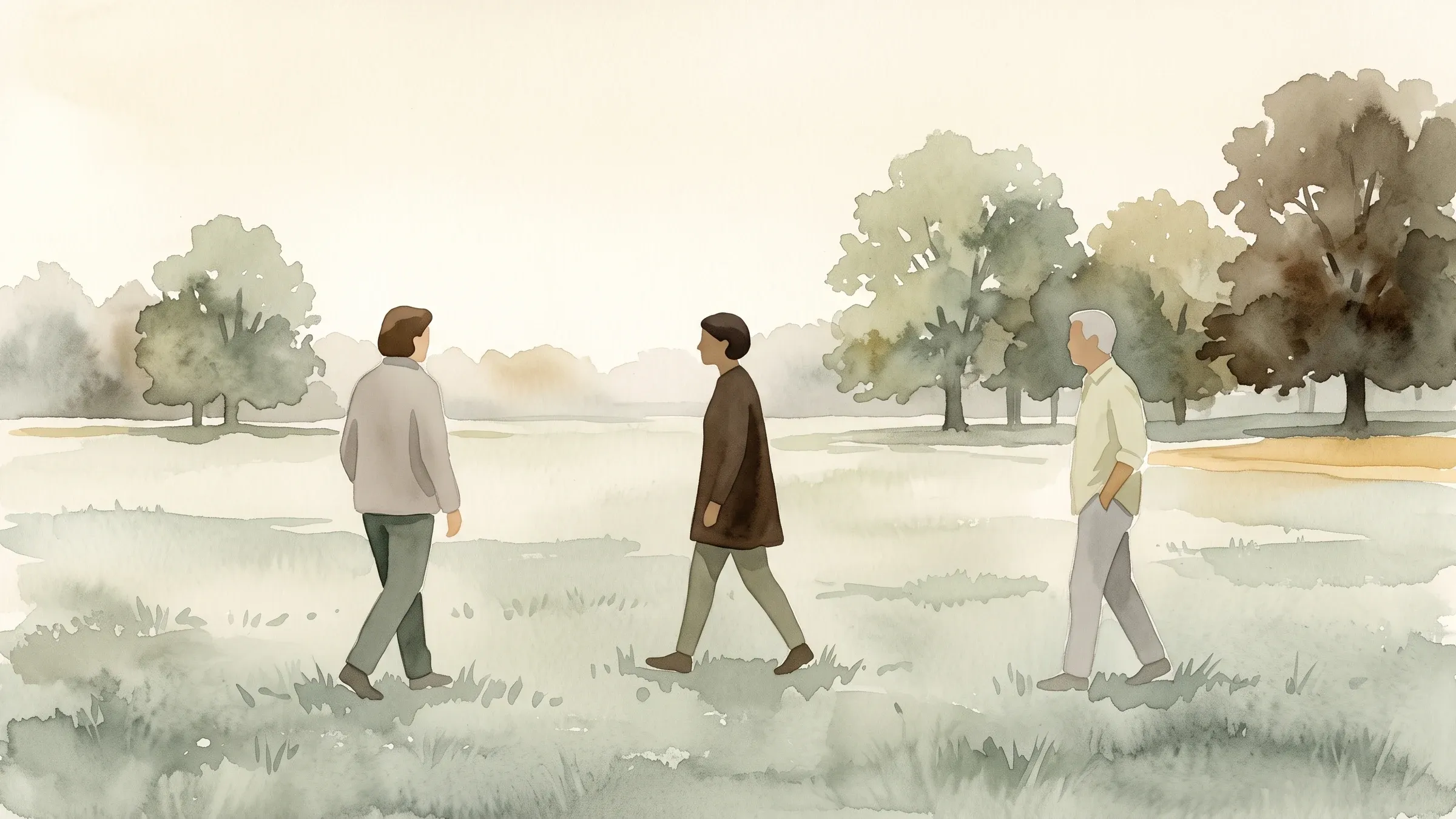
Tai chi walking’s slowness is what makes it the best walking practice for companionship. Two people doing it together aren’t walking at different paces — they’re inside the same deliberate rhythm. It works with parents, partners, grandparents, kids, or friends.
Here’s what every article online misses. Tai chi walking’s defining feature — its slowness — is exactly what makes it the best walking trend ever invented for companionship.
Think about it. A regular walk with your mom, who’s now in her seventies and doesn’t move as fast as she used to? You’re either holding back uncomfortably or she’s straining to keep up. A walk with a partner who’s recovering from knee surgery? Same problem. A walk with a friend who hates “exercise”? They’ll bail after two sessions because it feels like work.
Tai chi walking is different. The whole point is to be slow. Two people doing tai chi walking together aren’t “walking at different paces” — they’re both inside the same deliberate, meditative rhythm. Nobody is holding back. Nobody is straining. The slowness is the practice.
This is the mode you can do with:
- A parent who’s slowed down with age — finally a walk where neither of you is uncomfortable
- A partner recovering from injury, surgery, pregnancy, or burnout
- A grandparent who’d love to spend more time with you but can’t manage a real “fitness walk”
- A kid learning to be aware of their body
- A friend who’s not into fitness but is into hanging out
- Yourself, on the days when the idea of “exercise” feels like too much
Research on group walking programs is consistent: people who walk with others are far more likely to stick with it. A 42-study systematic review found that walking interventions with a social component have around 75% adherence — dramatically higher than solo walking programs. The same psychology applies even more powerfully to tai chi walking, where the stakes are low, the time commitment is small, and the activity itself is calming rather than draining.
The 7-minute version that’s going viral on TikTok? That’s the perfect format for a daily shared ritual. Seven minutes is nothing. Seven minutes is texting back and forth. Seven minutes done with someone you love, every day, for a month, becomes the kind of gentle anchor that quietly improves both your physical and emotional life.
How to make tai chi walking a daily ritual with the people you love
Pick one person, pick a time, start with 5 minutes. Walk in the same place if together, or your own neighborhoods at the same time if apart. Don’t talk for the first minute — let the slowness settle.
Here’s a simple format that works:
- Pick one person. Just one. Your mom, your partner, your sister, your best friend, your teenager.
- Pick a time. Same time every day works best — right after dinner, first thing in the morning, the 5pm slump. Anchoring it to an existing routine is a form of walking habit stacking that makes consistency almost automatic.
- Start with 5 minutes. Don’t be ambitious. Five minutes done daily beats 20 minutes done twice a week.
- Walk in the same place if you’re together, or in your own neighborhoods at the same time if you’re apart.
- Don’t talk for the first minute or two. Just settle into the slowness together. Then talk if you want, or stay quiet — both are good.
- Let it be the same every day. The point isn’t progress, it’s presence.
If you’re walking with someone who lives far away, you can still do this together. With Steps Club, when one of you starts a walk, the other sees you’re out there. It’s a tiny signal — I’m doing this, you can do it too — and it turns out that tiny signal is what makes the habit stick.
We built Steps Club because connection is the real motivation, not metrics. Tai chi walking is the same philosophy expressed as a walking practice — it’s not about the steps, it’s about the awareness and the people you’re with. The two go together naturally.
Create a private club for the people you’d actually do this with. Two people is enough. Walk together — even when you’re apart — and watch what happens after a month.