Last updated: September 14, 2026
In the two years after February 2020, the average Microsoft Teams user’s weekly time in meetings rose 252%, according to Microsoft’s 2022 Work Trend Index. Most of that time was spent sitting still, looking at a grid of faces that included your own.
Walking meetings get sold as the fix. Burn calories, boost creativity, bond with your team. Some of that holds up. Some of it is a stretch, and the stretch is exactly why so many walking meetings end with two slightly out-of-breath people who can’t remember what they agreed.
So this is the honest version. What the research on walking meetings actually shows, which conversations belong on foot and which don’t, how to run one step by step (including when you’re both remote), and why the walking meetings people keep having for years tend to be with someone they like.
What is a walking meeting?
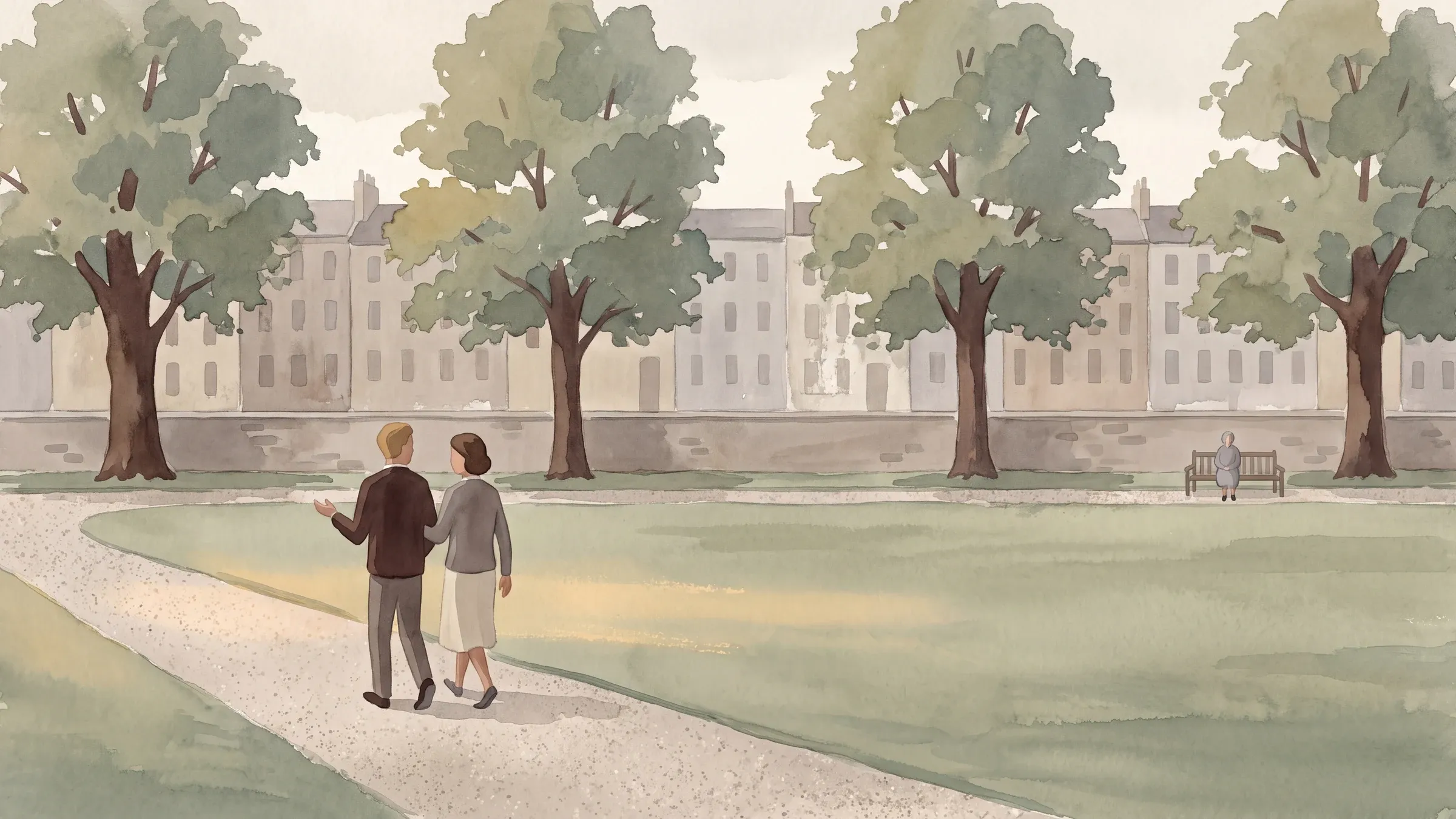
A walking meeting is a conversation held on foot instead of in chairs. Usually two or three people, 20 to 40 minutes, no screens. It can happen side by side in person, or on a phone call with each person walking wherever they are.
The idea is older than any office, though not quite in the way it’s usually told. Aristotle’s school in Athens was called the Peripatetic school, from a Greek word meaning “given to walking about”. The name most likely came from the covered walkways of the Lyceum where the school met. The story of Aristotle lecturing on the move is a later legend.
The modern habit has better paperwork. Walter Isaacson, Steve Jobs’s biographer, wrote that he “didn’t yet know that taking a long walk was his preferred way to have a serious conversation.”
There are three common formats:
- In person, side by side. The classic version. Two or three people, one route.
- Both remote. Each person walks their own streets on an audio call, cameras off.
- Mixed. One person walks while the other sits at a desk. It works, but only one of you gets the change of scene.
Walk-and-talk with friends more than colleagues? See how private clubs work in Steps Club →
Do walking meetings actually work?
For some jobs, yes. Walking reliably helps open-ended thinking, adds a modest amount of movement, and changes how a conversation feels. It does very little for precise, single-answer work. The evidence is real but small, so match the format to the meeting.
What does walking do to creative thinking?
It helps you generate ideas, not check them. In four experiments published in 2014, Stanford researchers Marily Oppezzo and Daniel Schwartz found walking improved divergent thinking for 81% of participants, but convergent thinking for only 23%.
The divergent test asked people to come up with new uses for everyday objects, which is brainstorming in miniature. The convergent test had a single right answer. The paper also found a creative boost that lingered after people sat back down, and outdoor walking produced the most novel analogies. Stanford’s write-up of the study put the average gain in creative output at about 60%.
Turn that into a meeting rule and it’s simple. A walk suits “what could we do about this?” It doesn’t suit “is this number right?”
How much extra movement does a walking meeting add?
A little. In the University of Miami’s Walking Meeting pilot, published in the CDC’s journal Preventing Chronic Disease, 17 office workers swapped one weekly seated meeting for a walking one. Work-time moderate-to-vigorous activity went from 107 to 117 minutes a week.
That’s about 10 minutes, and the study itself reports the change wasn’t statistically significant in a group that small. What it did show clearly was that people would actually do it: seven of the eight groups completed both of their walking meetings, and one participant called theirs “very energizing, very invigorating.”
So treat the health case as a bonus, not the reason. One walking meeting a week won’t change anyone’s fitness. It’s a better-feeling meeting that happens to get you out of a chair.
Why does walking side by side change the conversation?
Because you’re not staring at each other, or at yourself. Walking side by side takes constant eye contact out of the conversation, and a walking call has no self-view at all. Both effects show up in research, with caveats.
In a 2020 PLOS ONE experiment, 67 participants were paired into 186 pairs of strangers who walked 350 meters together. Even a silent walk nudged their impressions of each other upward, and a walk with conversation improved them more than twice as much.
Video calls push the other way. A Stanford-led study of 10,591 people found about 14% of women and 5.5% of men felt very or extremely fatigued after video meetings, and “mirror anxiety” from constantly seeing your own face helped explain the gap. A walking call has no mirror.
Which meetings should be walking meetings?
Walk the conversations where thinking matters more than looking at something. One-to-ones, brainstorms, stuck problems, mentoring, and catch-ups suit a walk. Anything that needs a shared screen, precise numbers, a big group, or privacy belongs at a desk.
| Walk it | Keep it seated |
|---|---|
| Weekly 1:1s | Budget, data, or document reviews |
| Brainstorming and “what if” sessions | Anything with a slide deck |
| Talking through a stuck problem | Meetings with four or more people |
| Mentoring and career conversations | Confidential topics in public places |
| Catch-ups with someone you rarely see | Any meeting where someone can’t, or would rather not, walk |
The seated column isn’t arbitrary. Hard mental work while walking has a measurable cost: a 2011 meta-analysis in Neuroscience & Biobehavioral Reviews found that doing a cognitive task while walking shows up most clearly as slower walking speed. Your body is quietly telling you it’s doing two jobs at once.
Imani manages a team of six. In March she moved every 1:1 onto a walk, then tried the quarterly budget review too. Forty minutes in, nobody could see the spreadsheet, two figures had been misremembered, and the whole thing had to be redone at a desk the next morning. That same week, a walking 1:1 finally untangled a hiring question that had stalled for a month. Same manager, same route. Different kind of meeting.
How do you run a walking meeting?
Ask first, pick one or two topics, walk a familiar loop at talking pace, and stop at the end to capture decisions. Keep it to two or three people and 20 to 40 minutes. That’s the whole method.
- Ask, don’t announce. “Want to do this one as a walk?” leaves room for a no. Offer a seated option without making anyone explain why. Mobility, shoes, weather, and energy are all fair reasons.
- Pick one or two topics. A walk favours depth. A seven-item agenda turns into a forced march.
- Choose a loop you already know. Quiet, flat, few road crossings, and ending where you started, so nobody’s navigating mid-sentence.
- Keep it to two or three people. Both University of Miami walking meeting studies used groups of two or three. Past that, the pavement splits you into side conversations.
- Walk at talking pace. Use the CDC’s talk test: at moderate intensity you can talk but not sing. If someone can only manage a few words between breaths, slow down.
- Stop to capture decisions. In the last two or three minutes, find a bench, say the decisions out loud, and have one person record a voice note or type them.
The pace rule matters more than it looks. In a 2021 follow-up study of 18 office workers by the same Miami team, very vigorous activity in the final walking meeting week correlated with negative mood (r = 0.69). Moderate activity, meanwhile, correlated with less health-related impairment at work. A walking meeting isn’t a workout. Stroll.
Theo walks fast. It’s how he’s always walked. When he started taking 1:1s outside, his answers got longer and his reports’ answers got shorter, until one of them admitted she spent every loop trying not to sound out of breath. He dropped his pace by what felt like half. The conversations got longer on both sides.
How do you have a walking meeting when you’re both remote?
Each person walks their own streets on an audio-only call, cameras off. Say it’s a walking call at the start, wear headphones with a decent mic, mute at busy crossings, and plan somewhere to stop for the last few minutes.
For remote workers this may be the best version of the format, because it removes the grid of faces entirely. University of Miami researcher Alberto Caban-Martinez put the case plainly in the university’s summary of the 2021 study: “walking outside on a safe, clear path while taking an audio/video work conference call can increase physical activity and affect mood.” It also turns a call you’d have spent sitting into a walk you didn’t have to find time for, which is the whole idea behind converting dead time into steps.
A simple setup:
- Headphones with a mic that handles wind. Phone speakers and traffic don’t mix.
- Say “I’m walking” at the top. It explains the background noise and gives the other person permission to walk too.
- Save quiet streets for the talking parts. Cross the busy junction while you’re listening.
- Keep your phone in your pocket. If you need to look something up, the meeting has become a seated one.
- End at your front door or a bench. That’s your note-taking desk.
If you’re building walks into a home-working day more broadly, our remote worker walking routine covers the morning, midday, and log-off walks around it.
What goes wrong with walking meetings, and how do you fix it?
Four things go wrong: the pace doesn’t suit everyone, nobody remembers the decisions, the weather turns, and someone agreed to walk because they felt they couldn’t say no. Each has a simple fix, and none of them mean abandoning the format.
- Pace mismatch. The faster walker sets the speed without noticing. Fix: let the slower walker lead, literally half a step ahead.
- The lost decision. Great conversation, no record of it. Fix: the stop at the end isn’t optional.
- Weather. Fix: have an indoor fallback, like a long corridor, a covered arcade, or a walking pad, rather than cancelling. Our indoor walking guide has more options.
- The quiet no. A walking meeting someone felt obliged to take is worse than a seated one. Fix: ask privately, keep the seated option easy, and never make walking the default for someone who hasn’t said yes.
It’s worth being clear-eyed about the evidence, too. Both University of Miami studies were small pilots, one with 17 people and one with 18, and the researchers themselves call for larger, longer studies. Walking meetings are a promising habit, not a proven productivity intervention. Anyone promising your team a measured percentage boost is going further than the data does.
Why do the best walking meetings happen with people you like?
Because a walking meeting is really a walk with someone, and walks with people you like get repeated. The same 2020 PLOS ONE study found pairs who formed a better first impression of each other fell into step more often on a silent walk.
That’s worth sitting with. The walking meetings that last for years usually aren’t the ones a manager scheduled. They’re the standing Tuesday call with a mentor, the Sunday phone walk with a sibling, the co-founder check-in on the same river path every week. The format sticks when the relationship is the reason for the walk.
Ruth and Sam have been friends since university and now live on opposite coasts. For a year they tried to schedule video calls and managed about one a month. Then they switched to a standing Sunday phone call, both walking. They’ve missed four in eighteen months. It turns out a walk you were already going to take, with the person you most want to talk to, doesn’t need scheduling willpower.
This is where Steps Club fits, so here’s exactly how. Steps Club isn’t a meeting tool or a workplace wellness app. It won’t schedule a walk, host the call, sync with your calendar, or track your route. What it does is give the people you walk and talk with a private club, where everyone’s steps sync automatically from Apple Health or Health Connect and each person sets their own goal. Start a walk and Live Walking Sessions lets your friends see you’re out there, even from another city.
A regular walking partner is one of the most reliable ways to keep walking at all, which we cover in our guide to finding a walking accountability partner. For the bigger picture, start with our complete guide to walking with friends.
Got a friend you already call every week? Make it a walking call. Get Steps Club free on the App Store or on Google Play. The free plan covers 2 clubs and 5 friends.
The short version
Walking meetings work best when you treat them as a conversation format rather than a workout, and pick them for the right conversations.
- Stroll, don’t march. Everyone should be able to talk in full sentences.
- Walk the thinking meetings. 1:1s, brainstorms, stuck problems. Sit for screens, numbers, big groups, and private topics.
- Two or three people, one or two topics, 20 to 40 minutes.
- Stop at the end and capture decisions.
- Ask, don’t assume. The seated option is always easy to choose.
- Remote works well. Audio only, cameras off, both walking.
The research on walking meetings is small but consistent in one direction: movement helps open-ended thinking and makes a conversation feel different. The rest is craft. And if the walking meetings you look forward to most turn out to be the ones with your friends, that isn’t a detour from the point. That’s the point.
Walk with your people, even from different cities. Create a private club and see each other’s steps without a single ranking. Steps Club is free to start on the App Store and Google Play.