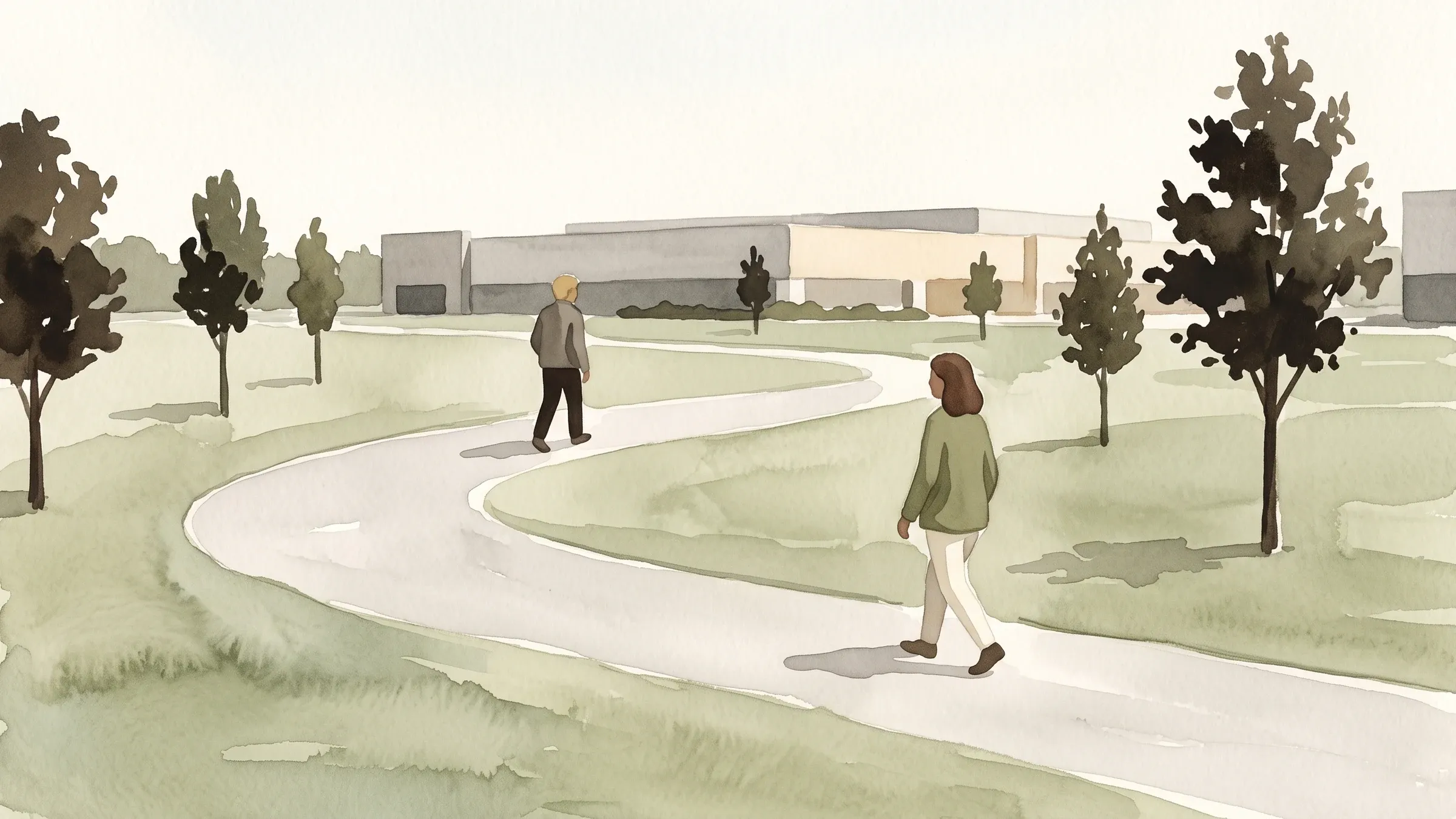
You told yourself remote work would make you healthier. More time for the gym. A real lunch. A walk whenever you wanted one.
Then the first Tuesday of the quarter hit, and the only steps you logged were kitchen-to-desk-to-bathroom-to-desk. Again.
Working from home is supposed to be the flexible option, but the honest version is that it strips out all the incidental movement most people don’t notice they rely on. The walk to the train. The coffee run with Amir from accounting. The five minutes between meeting rooms. Without a deliberate remote worker walking routine, WFH days quietly flatten into a single ten-hour chair-shape. This guide gives you a research-backed rhythm that works with your calendar, and a way to do it with your people so it actually sticks.
If you’d rather start with the social layer, our guide to walking with friends covers the ground-truth answer to the hardest part of any WFH walking habit. Come back here for the daily shape.
Why does working from home quietly break your walking habit?
Remote work removes incidental movement, not deliberate exercise. A PMC meta-analysis of 36 studies and 270,617 participants found WFH workers average 2,564 fewer steps and 31 more sedentary minutes per day, mostly because the commute and office interruptions disappear.
Those numbers line up with Stanford’s Center on Longevity Sedentary Brief, which puts full-time remote work at roughly 2 more hours of sitting per day compared to office work. None of that is your fault. It’s the physical geometry of the job changing. Your hallway is three feet long now.
The context behind those numbers matters. A JAMA Cardiology study of 105,000 participants across 21 countries found that sitting 8 or more hours daily is associated with 17 to 50 percent higher cardiovascular and early-mortality risk. A separate JAMA Network cohort of roughly 480,000 adults followed for 13 years found 16 percent higher all-cause mortality and 34 percent higher cardiovascular mortality for high-sitters.
This isn’t a reason to feel bad about WFH. It’s a reason to name the tradeoff out loud so you can do something about it. The good news: JAMA and Mayo Clinic reviews suggest 60-75 minutes of moderate daily activity offsets most of the prolonged-sitting risk. That’s achievable on a normal workday.
What’s the hidden cost of remote work nobody adds to the step conversation?
Loneliness. The 2023 U. S. Surgeon General’s advisory declared social isolation a public-health epidemic comparable to smoking 15 cigarettes a day. Remote work didn’t cause it, but it stripped out a layer of casual daily contact most people relied on.
Think about what an office day included that your WFH day doesn’t. The four-minute chat in the kitchen. The “heading out for coffee, anyone want anything?” The lunch walk with a coworker where you weren’t really talking about work. None of those were scheduled. You didn’t block them on your calendar. They just happened because bodies were in the same building.
Remote work optimized for focus, and it did. But focus is not connection. The same Surgeon General report notes that people who are socially disconnected show measurable drops in workplace performance and higher rates of anxiety and depression. Our own walking for mental health guide covers the clinical side of that link.
Here’s why it matters for a walking routine specifically: walking is already one of the rare habits that solves the physical problem (sedentary WFH) and the social problem (isolation) at the same time, if you design it to. Walking alone reduces the sitting risk. Walking with even one other person, synchronously or not, addresses both. Most remote-worker walking guides skip this half entirely. We’d rather put it up front.
If you’ve gotten this far and the social piece already sounds like the more interesting half, download Steps Club and we’ll come back to how it fits later in the article.
What does a good remote worker walking routine look like in a single day?
A working routine has three parts: a 10-15 minute morning walk as a pseudo-commute, a 15-20 minute post-lunch midday walk, and a 10-15 minute evening walk to close the workday. Total: 35-50 minutes, split so no walk feels precious.
Here’s the shape, on a featured-snippet-friendly list:
- Morning, before Slack opens (10-15 min). A pseudo-commute walk. Outside if possible. This is your buffer between home-you and work-you.
- Midday, after lunch (15-20 min). The focus reset. Short enough to fit between meetings, long enough to shift your brain chemistry.
- Evening, after your last meeting (10-15 min). The boundary walk. Signals to your body that the workday is over even when your office is your kitchen.
Every part is short on purpose. Remote workers don’t fail walking routines because they’re lazy. They fail them because the calendar wins. Three small walks that each fit a 20-minute window will survive your week. One aspirational 60-minute walk will not.
A note on step targets: a JAMA Network Open meta-analysis found measurable longevity benefits kick in around 7,000 steps, with diminishing returns above 10,000. If you nail this three-part routine on top of a normal WFH day’s incidental steps, you’ll usually land in that 7,000-10,000 band without chasing the number.
Why does a morning walk work so well as a pseudo-commute?
A 10-15 minute morning walk replaces the commute psychologically. It creates a clean start-of-work signal, hits you with morning light that resets your circadian rhythm, and (if you want) doubles as a walking 1:1 with a teammate via AirPods.
Priya is a product manager in Austin on a team that’s spread across three time zones. For two years her workday started the instant she opened the laptop, which meant she was answering Slack from bed by 7:45. She started taking her weekly 1:1 with her NYC-based eng lead as a walking call at 8am. Thirty minutes, AirPods, a coffee-shop loop. Her habit-stacking the walk onto an existing meeting meant no new calendar block. Her step count on Mondays went up 4,000. The 1:1s also got better. “We talk about actual things,” she told me, “because we’re not staring at the camera thumbnail of our own faces.”
Research backs up the walking-call instinct. The Stanford study from Marily Oppezzo and Daniel Schwartz found walking boosts divergent thinking by roughly 60 percent compared to sitting. The effect persisted briefly after sitting back down, too.
Making walking meetings actually work
A few ground rules so walking calls don’t become awkward:
- Use them for 1:1s or small groups of 2-3, not five-person standups. Ambient noise compounds fast.
- Say “I’m on a walk today” at the top. Everyone relaxes.
- AirPods or equivalent with wind-reduction. Your team shouldn’t hear your breathing through traffic.
- Not for every meeting. Save them for conversations where thinking matters more than screen-sharing. Our walking meetings guide sorts which ones those are.
The CDC has a workplace walking-meeting protocol that moved participants’ work-related physical activity from 107 to 117 minutes per week with almost no schedule friction. Remote workers have even less resistance to overcome than office teams did in that study.
Why is the midday walk the highest-leverage break in a WFH day?
The post-lunch walk is the most underrated part of a remote worker’s day. Fifteen to twenty minutes outside cuts the afternoon slump, supports digestion, and gives you the kind of loose-attention state where stuck ideas unstick.
Marcus is a solo founder in Denver. No coworkers, no scheduled breaks, nobody wondering where he went. For most of 2025 he worked through lunch at his desk because stopping felt like quitting. The result was predictable: every day around 2:45 he crashed hard, drank more coffee than he should, and wrote worse code than he had in the morning. A therapist pushed him to try a 15-minute walk after lunch, no phone, no podcast. Within three weeks he’d stopped the afternoon crash. More importantly, three of his five hardest product decisions that quarter landed mid-walk, not mid-desk.
The mechanism is partly research-backed. The Oppezzo/Schwartz creativity finding matters here too. So does the body of step count and mood research, which shows short daily walks produce measurable reductions in anxiety and low mood. Julie Broderick, a physiotherapy researcher at Trinity College Dublin, has published extensively on “movement snacks”, brief 2-10 minute activity bursts that bump energy expenditure by 5-10 percent and interrupt the metabolic damage of long sitting.
The shape that works for most remote workers: eat lunch, clear the plate, put shoes on, leave the apartment. Loop the block or the park. Back before your next meeting. None of it requires a new calendar block, which is the whole premise of how to walk more without finding extra time: convert the hours you already spend sitting into walking hours.
Why does an evening walk make a better log-off than closing the laptop?
Without a commute, the end of the workday has no physical shape. An evening walk, even just 10-15 minutes, creates a hard boundary between “working” and “off” when your office is your kitchen table.
This is the walk most remote workers skip because by 5:45pm they’re already on the couch. It’s also the one that changes the quality of the whole evening. Light exposure in the late afternoon supports healthy cortisol decline and sleep onset later. The cognitive mechanism is even simpler: you physically leave the place where you worked. You come back a person, not an employee.
You don’t have to go far. Around the block and back is enough. The shift happens because it’s deliberate, not because the distance is impressive.
How do you stay connected while you walk, the social layer most guides skip?
Remote workers have schedule flexibility but no built-in walking buddies. The practical fix is a small private-club step-tracking app shared with 3-5 real friends, where everyone sees each other’s walks live and can cheer without it feeling like a competition.
This is the part the search results get wrong. Search “apps for walking with friends in different cities” and you’ll get suggestions to use WhatsApp, Zoom, or generic public fitness apps. Those are communication tools, not shared-activity tools. They don’t solve the actual problem: I want to know my friend in another city started her morning walk, without texting her to ask.
Maya, Jamie, Devon, and Priya met in college and now live in four cities: San Francisco, Chicago, New York, and Austin. All four work from home. For a year they kept trying to schedule video calls to “catch up” and kept canceling. Last fall they all joined a private club on Steps Club. The shape of their friendship changed almost immediately. Maya sees Devon’s morning walk light up on her widget at 7:30 Pacific, which is 10:30 his time. She sends a reaction emoji from her laptop. Jamie’s evening walk in Chicago overlaps Priya’s midday walk in Austin, and they’ll occasionally call each other and walk together on opposite sides of the country. They’re not together. They’re walking together. Those are different sentences, and the second one is what remote workers actually need.
What to look for in a social step tracker for remote workers
A few things actually matter:
- Small private groups, not public leaderboards. You want your three friends, not a corporate step pool of 1,200 strangers.
- Live walking visibility. A signal that says “someone is walking right now” is the WFH replacement for “heading out for coffee, anyone want anything?”
- Wearable + phone sync. Apple Health, Apple Watch, Fitbit, Garmin, Oura, WHOOP. If you have to manually log, it won’t survive a busy week.
- No shame loops. No “you missed your goal” notifications. This is the whole point.
- Pick-up-and-put-down. You open it when you want to see your people. You close it and get back to work.
This is roughly the spec we built Steps Club to meet. Private clubs with no member cap. Live Walking Sessions so your friends can see you’re walking right now. Homescreen widgets so you glance at your phone and see whether Devon in Chicago has started his morning walk yet. Activity feed reactions instead of rankings. Our social step tracker deep-dive covers the full feature set, and our roundup of walking apps for groups compares the alternatives honestly.
If this sounds like the piece that’s been missing from your WFH setup, you can download Steps Club and have a club running in about three minutes.
What about walking pads? Where do they fit in a real WFH routine?
Walking pads help but they aren’t a full routine. Use one for meeting minutes and async work slots, and still leave the house for your morning and evening walks. Pads solve movement. They don’t solve light or social contact.
The cultural wave around walking pads is real, and the research supports them as a tool: even slow under-desk walking (1.5-2 mph) during meetings can move you from “mostly sedentary” to “lightly active” for several hours a day. That’s a legitimate improvement. But it’s also one input to a routine, not the routine itself. Pair it with outdoor walks and you get the physical benefits plus the psychological reset of actually going somewhere.
A practical layering: walking pad for the big block of meetings in the middle of the day. Outside for the morning pseudo-commute and the evening boundary walk. Rain day? Broderick’s Trinity College Dublin research notes that stair climbing produces an alertness bump roughly equivalent to a cup of coffee, and takes 90 seconds. Good fallback when the pad is covered in laundry.
If your main WFH-walking friction is weather or building constraints, our indoor walking guide goes deeper into walking-pad setups and bad-weather alternatives than this article has room for.
How do you actually make the routine stick on a chaotic WFH day?
The biggest threat isn’t motivation, it’s a back-to-back calendar. Block the walks like meetings, stack them on anchors you already have (coffee, lunch, log-off), and let a friend group see your steps. Two 10-minute walks beat one perfect 45-minute walk.
Five friction-killers in order of impact:
- Calendar-block all three walks. Make them meetings with yourself. “Morning walk 8:00-8:20” on a recurring daily event. If your calendar is shared with your team, even better, it normalizes the practice.
- Stack each walk on an existing anchor. Coffee trigger → morning walk. Lunch trigger → midday walk. Laptop-close trigger → evening walk. Our habit stacking guide covers why anchor triggers beat willpower every time.
- Turn 1:1s into walking calls. You were going to be on that call anyway. AirPods in, shoes on, walk-and-talk. Instant habit, zero new time.
- Let your friends hold you accountable. Research consistently shows people with a strong circle of close friends stay active far more reliably than those going it alone. In one NHANES study, older adults with the most close friends (six or more) were 2.71 times more likely to meet recommended activity guidelines than those with none (Loprinzi & Joyner, 2016). An accountability partner who’s also WFH is particularly high-leverage because you’re in the same situation.
- Lower the bar on bad days. A 5-minute walk counts. A lap around the block counts. Remote-work weeks are uneven. Perfectionism is the enemy of the routine.
A tactical note that helps more than it should: leave your walking shoes by the front door, not in the closet. The first friction point in most skipped walks is “I have to change shoes.” Remove that and you’ll take more walks than you plan to.
Jackie is 58, a hybrid worker who goes into the office Monday, Wednesday, and Friday. On office days she walks with a coworker at lunch. Tuesdays and Thursdays are remote. For months those were her lowest-step days by a wide margin. What changed the pattern wasn’t discipline. It was her two daughters, who both also work from home, joining a Steps Club private club with her. Now her WFH days are actually her highest-social days, because she sees their walks light up across the widget, and she calls one of them most afternoons to walk together on opposite coasts. The routine works because the social piece makes the walks worth taking.
Pulling it all together
Most remote-worker walking guides treat the problem as a logistics puzzle: here are some breaks, here’s a walking pad, good luck. The real problem is bigger and simpler. Working from home quietly removed your incidental movement and your casual social contact at the same time, and a working routine has to solve both.
The three-part rhythm handles the movement. Morning as pseudo-commute. Midday as focus reset. Evening as log-off ritual. Thirty-five to fifty minutes, in pieces your calendar can actually swallow.
The social layer handles the rest. A private club of 3-5 friends who can see your steps changes the math. You’re not walking alone in your neighborhood. You’re walking with your people, who happen to be walking in their neighborhoods. The Surgeon General has been asking us to build this kind of connection deliberately. Walking is one of the cheapest, most universal ways to do it.
If you want to try the whole package, download Steps Club and invite three friends. Text them the link. Take your morning walk tomorrow. See what the rest of the week looks like.
Whatever shape your routine takes, walking with your people beats walking alone.