Spring rain is hitting the window for the fourth day in a row. You’ve been at your desk seven hours. Your step count is at 1,842 and you can feel it. Going outside sounds miserable. Staying inside feels like giving up.
There’s a third option, and it already has a name. Indoor walking is having a real moment, with Google reporting more than 10,000 monthly searches for “indoor walking workouts” and walking pads selling faster than the companies can ship them. Rainy springs, work from home, noisy cold-weather stretches, and unsafe neighborhoods have all pushed people back inside looking for steps.
Here’s the thing most articles about indoor walking miss: the routes and the equipment are the easy part. The hard part is that indoor walking is usually lonely. You, a YouTube instructor you’ll never meet, and the hum of a walking pad. That’s the real reason so many people start and stop.
This guide covers the four modes of indoor walking, the research on whether it actually works, equipment you might need (and might not), and the one thing nobody else is writing about: how to make indoor walking social, even when you’re alone in your apartment. If you want to skip ahead, Steps Club is the piece most indoor walkers are missing.
What is indoor walking?
Indoor walking is any walking done inside, including walking in place, around-the-house routes, stair loops, mall walking, or using a walking pad or treadmill. It is weather-proof, joint-friendly, and counts the same as outdoor walking toward your daily step goal.
Most articles jump straight to prescriptions without defining the category. That’s a problem, because “indoor walking” is not one thing. It’s four.
The four modes of indoor walking:
- Walking in place, no equipment, no space. March during TV ads, commercials, or Zoom calls.
- Around-the-house routes, loops through your home, perimeter laps, stairs, hallway back-and-forths.
- Mall walking, indoor malls open early for walkers. Climate-controlled, safe, flat.
- Walking pad or treadmill, a mechanical assist so you can keep pace while working or watching something.
“Anything that gets you moving instead of just sitting or lying down is beneficial,” Jordan Boreman, an exercise physiologist at the Cleveland Clinic, told the publication. That framing matters. Indoor walking doesn’t need to look like outdoor walking to count. Marching in place while your coffee brews is real walking. So is pacing the kitchen during a phone call.
Does indoor walking actually work?
Yes. The American Heart Association and the CDC both recognize indoor walking as counting toward the 150 minutes per week of moderate-intensity physical activity adults need. When pace and duration match outdoor walking, the cardiovascular benefits are equivalent.
The numbers back this up across several measures:
- 150 minutes per week of moderate-intensity activity is the target, per the American Heart Association and the American College of Sports Medicine.
- 100 to 200 calories in 30 minutes of walking in place, according to the Cleveland Clinic, depending on pace and body size.
- 500 additional daily steps is associated with a 7% lower risk of heart disease, per research cited by Woman & Home. That’s roughly 5 minutes of extra walking.
- 4,000+ daily steps is the threshold where all-cause mortality risk starts dropping meaningfully, a finding TODAY cited from recent step-count research.
- 7,500 steps is the realistic starting goal for most adults, with 10,000+ as progression, according to ACSM guidance.
A 2023 walking-pad workday study referenced by TIME found that office workers using under-desk pads reported more energy, better mood, sharper focus, and less back and hip pain after several weeks. Those outcomes make a walking pad worth more than the hardware if you work from home.
The mechanism is the same as outdoor walking. Your heart rate goes up. Your muscles move. Your circulation improves. The sun and fresh air are nice. The movement is the medicine.
How do you walk indoors without any equipment?
You can walk indoors with nothing more than a hallway and a pair of sneakers. March in place during TV ads. Walk the longest loop of your home back and forth. Add stairs. Mix side steps, knee lifts, and arm swings to hit 3,000 to 6,000 steps a day without buying a thing.
Around-the-house routes that actually work
Pick the longest possible loop in your home. A big one: front door to kitchen to bedroom to hallway and back. In a one-bedroom apartment, that loop might be 40 feet. That’s fine. Twenty laps is 800 feet. Another forty laps is another 800. Stack those through the day and you’ve covered real distance without leaving the house.
Add stairs if you have them. Stairs are a step-count accelerator and a quiet cardio kick. A 2-story home gives you a built-in interval. Ten up-and-downs during a podcast is 200+ steps and a noticeable heart-rate bump.
The four no-equipment moves
When there’s not enough room for a route, use in-place moves. The four basics:
- March in place, knees up to hip height, arms swinging.
- Side steps, step right, bring left to meet it. Repeat left. Great for commercial breaks.
- Knee lifts, slower and more deliberate than a march. Better for small spaces.
- Heel taps, tap your heel out front, alternate sides. Low impact, good for recovery days.
Thirty minutes of these, mixed, covers about 3,000 steps for most people.
Mall walking, still underrated
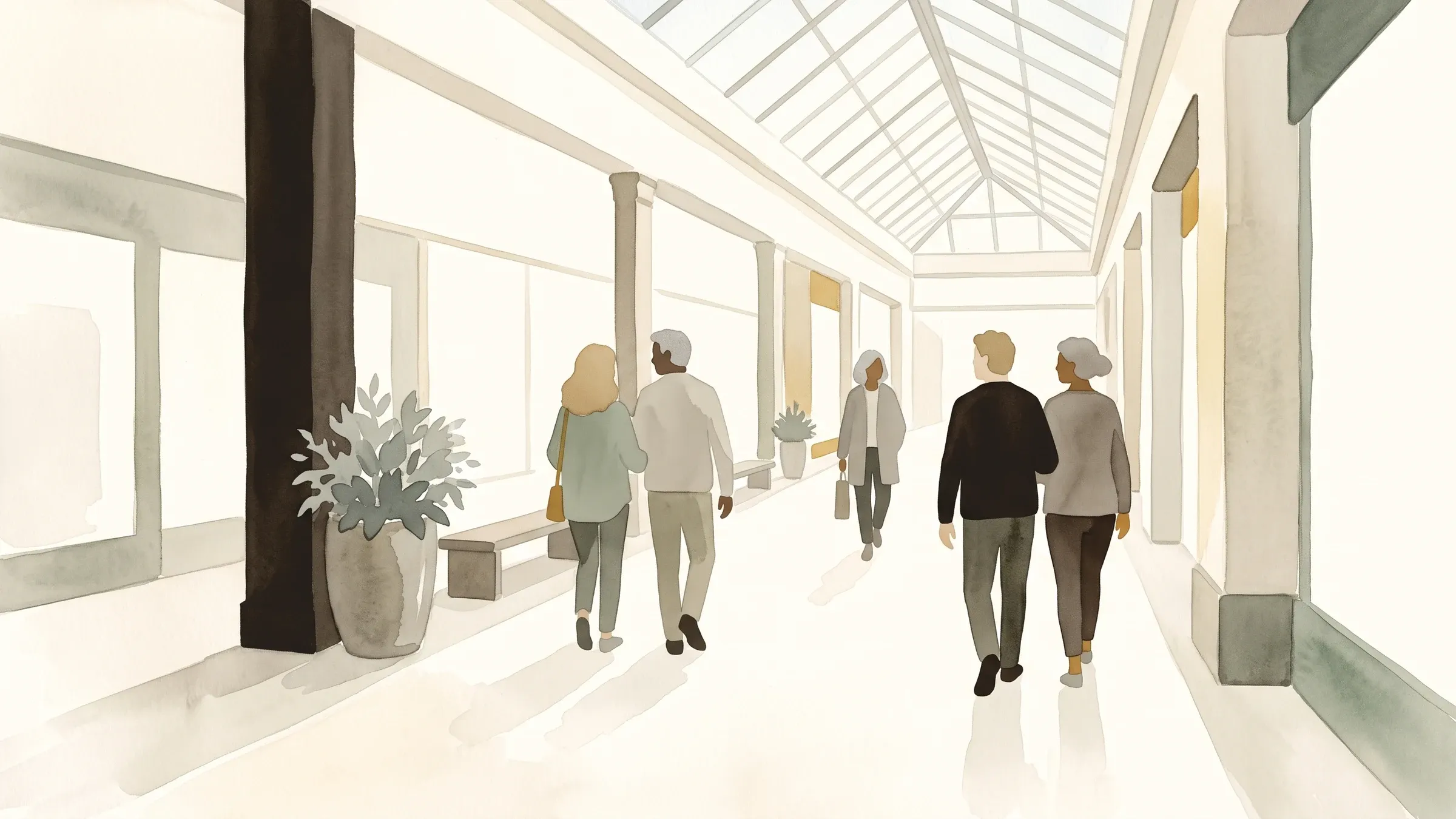
Most malls open an hour or two before the stores do. That’s when mall walkers show up. It’s indoor, climate-controlled, flat, safe, and surprisingly social. Bring a friend or a parent. A mile at most malls is about four or five laps. Grandma joining your walking routine from her Saturday mall walk is exactly the kind of thing Steps Club was built for.
Walking pads and treadmills, what’s actually worth it?
A walking pad is a compact, foldable treadmill that fits under a desk or bed. It’s best for working from home and small apartments. A traditional treadmill suits larger spaces and higher speeds. You don’t need either to walk indoors, but one of them might change your life if you sit all day.
Here’s the honest comparison:
| Walking pad | Traditional treadmill | |
|---|---|---|
| Max speed | 4 mph (walking only) | 10-12+ mph (walk, jog, run) |
| Footprint | Fits under a desk or bed | Dedicated floor space |
| Weight | 30-50 lbs, portable | 200+ lbs, not portable |
| Price | $100-400 | $500-3,000+ |
| Noise | Quiet, office-friendly | Louder |
| Best for | WFH desks, small apartments | Runners, larger homes |
Steps per hour on a walking pad, at typical pace: about 4,000 at 2 mph, 5,000 at 2.5 mph, and 6,000 at 3 mph. Most walking pads top out around 4 mph, which is a very fast walk. At that speed you’ll hit closer to 7,000 steps per hour but you won’t be typing emails.
When a walking pad is worth it
Buy the walking pad if you work from home 4+ days a week, you have a small apartment, and you find yourself hitting 2,000 steps by 6 pm on a regular day. The pad solves a specific problem: sedentary desk hours. At ~5,000 steps per hour at a gentle work-compatible pace, two hours on the pad over a workday doubles most office-bound people’s daily totals. The pad is one tool in a wider routine — our remote worker walking routine covers how to layer the pad with a pseudo-commute walk, a midday reset, and a log-off walk so WFH days don’t quietly flatten into chair-shape. And for the full research verdict, buying checklist, and how to keep the pad from becoming a clothes rack, see our dedicated walking pad guide.
Chris Dempers, an ACSM-certified exercise physiologist quoted in TIME, flagged the 2023 workday study for a reason. It isn’t about the pad. It’s about replacing otherwise-sedentary hours with active ones.
When to skip it
Skip the walking pad if you have a multi-story home with stairs, a hallway long enough to loop, or a mall within a ten-minute drive. The equipment is a shortcut, not a requirement. A hallway is free.
How do you get 10,000 steps indoors?
Stack sessions instead of grinding one long walk. A 30-minute walking pad block plus 15 minutes of marching during TV plus stair loops plus phone-call pacing adds up to 10,000 steps without stepping outside. Three 15-minute sessions beats one 45-minute push for most people.
Break it up
The research on habit formation favors short, stacked sessions over a single long effort. This is the core idea behind walking habit stacking: attach short walks to things you were going to do anyway. Phone calls. Podcast episodes. Post-meal cleanup. Commercial breaks.
A realistic 10,000-step indoor day:
- Morning: 25-minute walking pad session during standup meetings (~4,500 steps)
- Mid-morning: walk to the kitchen, fill water, lap the living room twice (~400 steps)
- Lunch: 10-minute phone-call walk around the apartment (~1,000 steps)
- Afternoon: second 20-minute walking pad block during a podcast (~3,500 steps)
- Evening: 15-minute TV march with side steps (~1,800 steps)
Total: about 11,200 steps, none of them outdoor.
Guided videos if you hate the silence
There’s a whole genre of YouTube creators who’ve built careers on indoor walking workouts. Leslie Sansone’s Walk at Home series is the classic, with 20-to-45 minute guided routines you can do in a living room. Grow with Jo and Schellea Fowler have built loyal followings doing similar work for a younger audience. Hit play, follow along, hit 3,000 to 6,000 steps in a single workout, and never set a foot outside.
Maya’s rainy-week plan
Maya, a 34-year-old product manager in Seattle, lost outdoor walking for four straight rainy days last spring. Day one, she was miserable. Day two she tried stacking. She hit 10,800 steps before dinner by doing a 25-minute walking pad session before her 9 am standup, two lap-the-house walks between meetings, and a post-dinner stair set with her roommate. She posted her totals in her Steps Club feed. Three friends reacted before she went to bed. The reactions didn’t change her step count. They changed whether she did it again on day three. She did.
The thing nobody talks about: indoor walking is lonely
Most indoor walking happens alone. A YouTube instructor, a podcast, the hum of a walking pad. That’s why it’s hard to stick with. Walking with friends, even remotely, is the single biggest adherence multiplier the research has found, and indoor walking is where the loneliness is sharpest.
Every publisher article on this topic tells you to walk in your living room. None of them tell you it’s going to feel strange, then a little sad, then after two weeks genuinely lonely. Outdoor walking has scenery, weather, chance encounters with neighbors, a sense that the world is out there. Indoor walking has a wall.
People who walk with others stick with the habit about 75% of the time, per a 42-study systematic review, far higher than solo walking typically manages. The effect size is bigger than any app, any tracker, any piece of gear. And it applies indoors just as much as outdoors. Probably more.
There are two ways to bring people into an indoor walk:
Async: your steps land in your club feed. You walk on your pad Tuesday at 3 pm. Your friends see the session show up in the feed. Someone drops a reaction. You didn’t have to coordinate a time. You didn’t have to talk. You just knew your people would see it, and they did. For many people this is enough to keep them going.
Sync: walk together from different places. Prop your phone against a cookbook or a water bottle. Start a Live Walking Session or FaceTime. Hit play on the same playlist. Walk for 30 minutes together from two different apartments. This is what walking with friends looks like when the outdoor version isn’t possible.
David and Priya’s Sunday pad walk
David and Priya are a long-distance couple. He’s in Austin, she’s in Brooklyn. Sundays at 9 am eastern, they start a Live Walking Session. He’s on a walking pad in his living room. She’s on a small apartment treadmill. Same playlist, forty-minute call. Her session ends at 3,200 steps. His ends at 3,800. It doesn’t feel like a workout. It feels like the Sunday walks they used to take when they lived in the same city. Starting a small walking group, even one of two, is the gentlest accountability there is.
Ready to try this? Download Steps Club and invite one person. A long-distance friend, a sibling, your mom. Indoor walking, together.
Why is indoor walking having a 2026 moment?
Walking pads turned WFH sedentary hours into active ones. Japanese walking and silent walking made walking culturally cool again. Remote work and unreliable weather made outdoor inconsistency a real pattern. Indoor walking solved all three at once.
The trend data is striking. The Japanese walking method is up +2,968% YoY in searches, silent walking keeps growing, and “walking pad” has gone from zero to mainstream in three years. The old stigma around indoor walking, that it was a compromise, is mostly gone.
A few reasons it stuck this time:
- Walking pads got cheap. A usable pad is now $150-250. That’s a rounding error next to a gym membership.
- WFH is permanent for a lot of people. 30% of US workdays happen at home as of late 2025. Desk hours need active options.
- Weather anxiety is real. Climate-driven spring rain, wildfire smoke, extreme heat, cold snaps all push people inside.
- The walking trend is broader. Silent walking, Japanese-method interval walking, rucking, walking culture is having a moment, and indoor walking is riding the wave.
The one thing that hasn’t kept up with the trend? The social layer. Apps that matter for outdoor walking often fall flat indoors. Your walking pad session reads as “a little block of activity” in most trackers. In Steps Club, it reads as “your friend walked at 3 pm,” and someone drops a reaction. That’s the difference.
How does indoor walking compare to walking outside?
For pure cardiovascular benefit, indoor walking and outdoor walking are equivalent when intensity and duration match. Outdoor walking adds sunlight, fresh air, scenery, and social chance encounters. Indoor walking adds consistency, safety, climate control, and productivity compatibility.
The honest answer is they complement each other. Outdoor walking when the weather and schedule allow. Indoor walking when they don’t. Nobody needs to be dogmatic about this. The best walkers combine both.
Where outdoor wins: vitamin D, novelty, mood benefits from nature, bigger range of pace and intensity, the psychological reset of leaving your space. A Harvard overview lays out the broader picture on walking’s benefits.
Where indoor wins: no weather dependency, no traffic, no commute to a walking route, easier to stack with work or chores, safer in unfamiliar neighborhoods or bad weather, predictable pace for interval training.
For a specific example of how to blend them: the Japanese walking method is arguably even easier to do on a walking pad than outside, because you can set the exact speed for the three-minute fast intervals. Silent walking, on the other hand, benefits from being outdoors. Match the practice to the setting.
The Chen family, three generations, same club
The Chen family runs an indoor-walking setup across three generations. Grandma walks the mall program three mornings a week, usually 2,800 steps per session. Mom uses a walking pad during her WFH Tuesdays, averaging 5,000 steps. Teen nephew does stair laps during homework breaks, usually around 1,500. They’re all in one Steps Club with personal goals per person, no rankings, no leaderboards. Nobody is competing. Nobody is being shamed. Everyone sees everyone’s steps, and that is the whole point.
What’s the easiest way to start indoor walking this week?
Start with 10 minutes today, not 30. March in place during your next TV episode or Zoom stand-up meeting. Check your phone, that was probably around 1,000 steps. Tomorrow, do it again. By week two, add a hallway loop or a 15-minute guided video.
Here’s a 7-day indoor starter plan that does not require any equipment:
- Day 1: 10 minutes of marching in place during a show. About 1,000 steps.
- Day 2: Same, plus walk your longest hallway 10 times between meetings. ~1,400 steps total.
- Day 3: Try a 15-minute guided YouTube indoor walking video. ~2,000 steps in one session.
- Day 4: Rest or repeat Day 1. Don’t skip the rest.
- Day 5: Stack three 10-minute sessions throughout the day. ~3,000-3,500 steps.
- Day 6: Add stairs if you have them. Ten up-and-downs during a podcast.
- Day 7: Invite someone. FaceTime your sister while you both walk in your own homes. This is the accountability partner setup that makes it stick.
Then keep going. Moving from 2,000 to 10,000 steps a day is not a willpower problem. It’s a stacking problem and a loneliness problem. Indoor walking can solve both.
The real answer
Indoor walking works. The equipment is optional. The routes are free. The research says the cardiovascular benefits match outdoor walking when you match the effort.
The thing most articles won’t tell you: it’s not the walking that’s hard. It’s the walking alone. Your living room at 3 pm on a rainy Tuesday feels different when your sister is also walking in her kitchen in another city, and you both see each other’s steps show up in the same feed. The mechanics are the same. The experience is different.
Walking indoors counts. Your people seeing that you walked counts more. Your mom’s mall-walking steps, your roommate’s stair loops, your long-distance best friend’s walking-pad sessions, they can all live in the same place.
Download Steps Club free on the App Store or Google Play. Start one club with one person. Walk in your living room. Let them see it. Let them cheer. That’s indoor walking the way it’s actually supposed to feel.