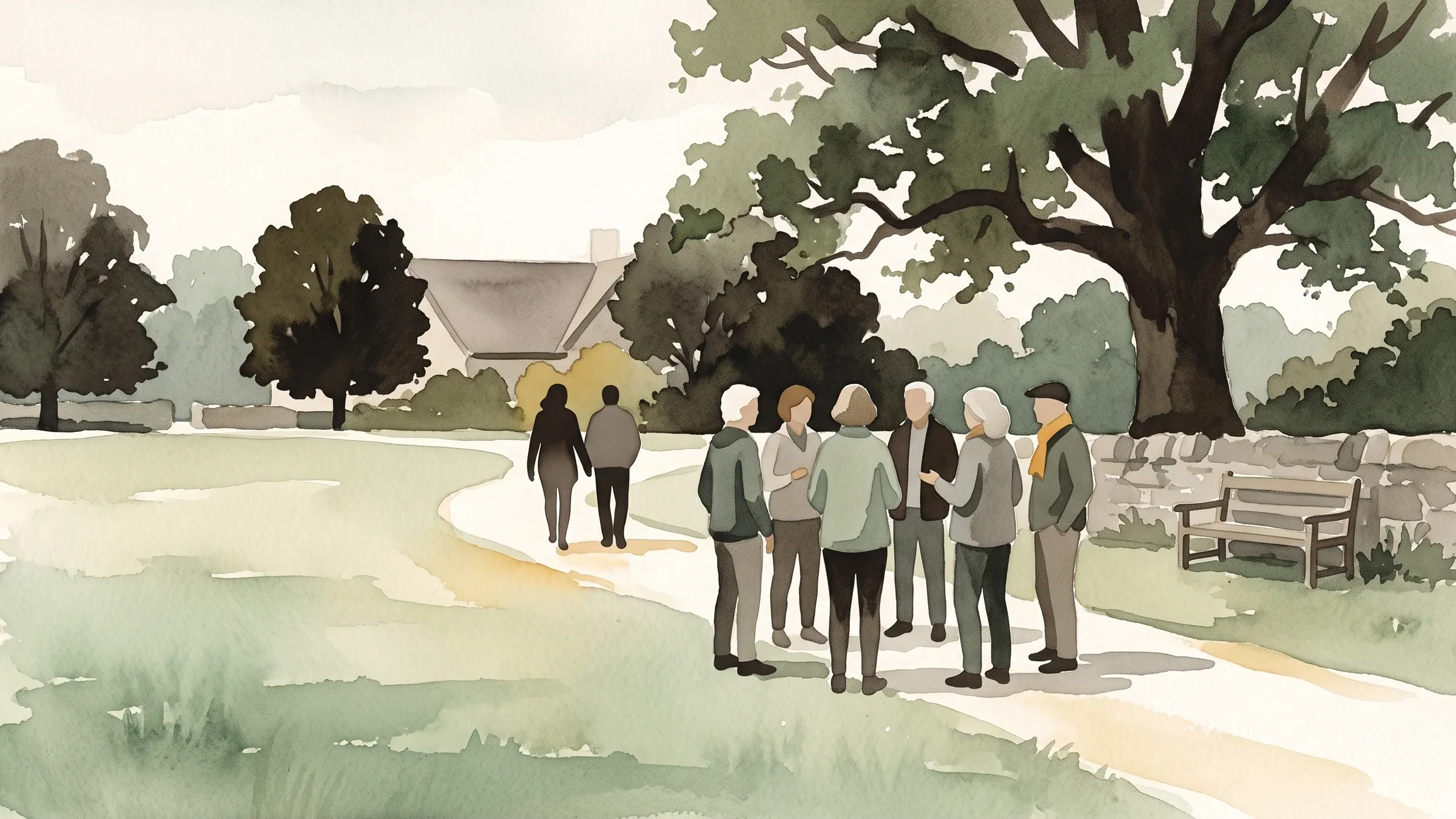
Clubs on Strava nearly quadrupled in 2025, crossing one million in total. Hiking clubs grew 5.8x. Running clubs grew 3.5x. The fastest-growing thing in fitness isn’t a workout. It’s belonging to a crew.
Walking clubs are riding the same wave, and if you’re in one (or want to be), you’ve probably hit the same wall: the club exists, but the connection between walks doesn’t. The group chat goes quiet. Nobody knows who’s still walking on the days you don’t meet.
That’s the job of a walking club app. In this guide, you’ll learn what one actually does, why a club needs different software than a step challenge, and which app fits your kind of club, whether it meets on a sidewalk every Saturday or lives entirely in your phones.
What is a walking club app?
A walking club app connects a defined group of walkers by syncing each member’s daily steps automatically and sharing them in one place, so the club stays visible to each other between walks, without manual logging or public profiles.
The mechanics are simple. Your phone or watch already counts your steps. The app reads that count through Apple Health or Health Connect and shows it to your club. Some apps add scheduling tools for real-world meetups. Others add a social feed, reactions, and live walk visibility.
The word “club” matters here. A club isn’t an audience of strangers, and it isn’t a 30-day event. It’s a specific set of people who keep showing up for each other. The best apps in this category are built around that shape. We cover the broader landscape in our guide to walking with friends.
Walking club vs step challenge: what’s the difference?
A walking club is ongoing and relational: the same people, no end date. A step challenge is an event: fixed dates, a winner, then it ends. Clubs need an app built for daily connection, not tournament brackets.
This distinction decides which app will still be alive on your phone in six months. Challenge apps generate a burst of activity, then the challenge ends and the feed goes silent. Clubs don’t end. What keeps a club warm is smaller and steadier: seeing that your friend got her steps in, reacting to a goal hit, noticing someone’s out walking right now.
Renee runs a Saturday-morning walking club that meets at a trailhead outside Sacramento. Eight regulars, three years running. Last fall they tried a challenge app for October. It worked for October. By mid-November the app was dead weight, because it had nothing to say about an ordinary Tuesday. What her club actually needed was a quiet feed of each other’s ordinary Tuesdays.
If your club sounds like Renee’s, Steps Club is free to try. Create a private club, invite your regulars, and your weekday steps show up next to each other automatically.
What should a walking club app actually do?
A walking club app should sync steps automatically, keep the club private, celebrate goals without ranking people, work across iPhone and Android, and make it effortless to see how everyone’s doing at a glance.
Here’s the checklist worth carrying into any app store search:
- Automatic syncing. Steps flow in from Apple Health or Health Connect. If members have to log walks by hand, participation decays within weeks.
- Any wearable. Apple Watch, Fitbit, Garmin, WHOOP, Oura, or just a phone in a pocket. Clubs are mixed-device by nature.
- Privacy by default. Invite-only membership, no public profiles. Your club’s steps are the club’s business.
- Celebration over ranking. Reactions and goal celebrations keep mixed-pace clubs together. Leaderboards quietly push the slowest members out the door.
- Personal goals. A retiree’s 6,000-step day and a mail carrier’s 15,000-step day should both count as wins.
- Both platforms. One Android member shouldn’t disqualify the whole club.
No single feature is exotic. The rare thing is an app that treats all six as the point rather than an afterthought.
Which walking club app fits your club?
It depends on what kind of club you have. Steps Club fits clubs that live in the app. Muvn and Meetup fit organizers of real-world meetups. StepUp and Stridekick fit big workplace-style groups. WalkClub is dormant, skip it. Stompers is active and good fun, but it’s a gamified daily race with avatars and sabotage items rather than a club.
“Walking club app” really means two different jobs, and it’s worth knowing which one you’re hiring for.
For a club that lives in the app: Steps Club
If your club is a group of friends, a family, or a scattered crew that can’t share a sidewalk, Steps Club is built for exactly this. You create a private, invite-only club (there’s no member cap, and it’s designed for small groups where everyone knows everyone), members’ steps sync automatically, and the feed fills with goals hit and walks started instead of rankings. Everyone sets their own daily goal. When someone heads out, Live Walking Sessions show the club that they’re out there, and if you’re walking at the same time, you see each other side by side.
It’s on iPhone and Android (Android shipped on Google Play in July 2026), and the free plan covers 2 clubs and 5 friends. Pro is $4.99 a month for unlimited clubs and friends.
For organizing a real-world club’s meetups: Muvn or Meetup
If your club’s center of gravity is the Saturday meetup, you need scheduling more than a feed. Muvn pitches itself directly at run club captains and walking group leaders, with event scheduling and member management; note that it’s young (too few App Store ratings to display a score), its last update shipped in June 2025, and organizer features sit in a $9.99-a-month tier. Meetup remains the discovery engine if you want strangers to find your club. Many real-world clubs pair one of these with a step app for the six days a week they’re apart. Our guide on how to start a walking group covers the people side.
For big workplace-style groups: StepUp or Stridekick
If “club” in your case means 200 coworkers, you want challenge infrastructure: leaderboards, team brackets, admin tools. StepUp and Stridekick both do this well and run free tiers. Our group walking app guide breaks down why big groups need different software than small crews.
Apps to skip in 2026
Two near-name apps show up in searches but haven’t earned a spot here. WalkClub hasn’t shipped an update since April 2023 — a club is a long-term commitment, so don’t build one on abandoned software. Stompers is the opposite case: actively maintained, well-liked, and genuinely fun, but it’s a game rather than a club. Everyone gets an avatar, the day is a live race, and you spend items on sabotaging whoever’s ahead of you. That’s a brilliant Tuesday and a difficult year. Clubs are about showing up together; races are about who won today, and the ranking in Stompers can’t be turned off.
| App | Best for | Platforms | Model | Free tier |
|---|---|---|---|---|
| Steps Club | Clubs that live in the app: friends, family, long-distance | iPhone + Android | Private clubs, feed + reactions, no leaderboards | 2 clubs, 5 friends |
| Muvn | Organizing real-world meetups | iPhone | Club events + member tools | Free to join; organizer tier $9.99/mo |
| Meetup | Public club discovery | iPhone + Android + web | Event listings | Free to browse |
| StepUp | Large workplace groups | iPhone + Android | Leaderboards + team challenges | Free challenges |
| Stridekick | Cross-platform challenge crews | iPhone + Android | One challenge at a time | Free basic challenges |
| WalkClub | Not recommended | iPhone | Dormant since April 2023 | n/a |
| Stompers | Crews who want a gamified race, not a club | iPhone | Active (v1.8.2) | Free + IAP |
And if there’s a real-world club near you worth joining, our walking club near me guide covers how to find one.
Do walking clubs actually make you healthier?
Yes, measurably. A systematic review of 42 studies covering 1,843 people, published in the British Journal of Sports Medicine, found walking groups significantly lowered blood pressure, resting heart rate, and body fat, and improved depression scores.
The numbers from Hanson and Jones’s meta-analysis deserve spelling out: systolic blood pressure fell 3.72 mmHg, resting heart rate dropped 2.88 beats per minute, and body fat came down 1.31 percentage points. The authors’ summary line is the part worth framing: walking groups are “effective and safe with good adherence.”
That adherence point is the club’s real advantage. A club doesn’t make any single step healthier. It makes the steps keep happening, because someone notices when you don’t show up. Solo walking plans have no such witness.
Can a walking club be entirely virtual?
Yes. A virtual walking club shares steps through an app instead of meeting on a sidewalk. Members walk in their own cities on their own schedules, and the club exists in the shared feed, the reactions, and walks that overlap in time.
This is how scattered friend groups make a club work. Priya’s college roommates, split between Boston, Denver, and Austin, have run a three-person club since February. Nobody’s shared a sidewalk in years. But when Priya starts her lunch walk and sees her Denver roommate is out walking at the same moment, the two of them are, in every way that matters to her, walking together. When her Boston roommate hits her goal at 9pm, the other two pile on reactions.
Research backs the instinct that this connection is the point. In Strava’s 2025 Year in Sport report, which surveyed more than 30,000 people, 58% said they’d made new friends through fitness groups. Movement is how a lot of us do friendship now. A virtual club just removes the geography requirement.
Scattered crew? Get Steps Club on the App Store or Google Play, start a club, and drop the invite link in the group chat.
How do you keep a walking club alive past month three?
Keep the club small enough that absence is noticed, celebrate goals visibly and often, and anchor the week with one repeating ritual. Clubs die from silence, not from missed walks.
Month three is where clubs quietly fold. The novelty is gone, a few members lapse, and nobody wants to be the person who says “are we still doing this?” Three habits reliably carry a club past it:
- React to everything. A one-tap reaction to a goal hit costs nothing and tells a member they were seen. Motivation research on small groups (the Köhler effect, confirmed in a 2023 meta-analysis of 19 studies in Kinesiology Review) shows people persist longest when they can see a slightly-more-active peer keep going. Visibility is the mechanism.
- Keep one ritual. A Saturday trailhead meetup, a Wednesday lunch walk, a Sunday recap message. One fixed point per week is enough structure for a club that isn’t an event.
- Let bad weeks be bad weeks. A club member who logs 2,000-step days for a week needs a wave, not a warning. Clubs that shame lapses lose the lapsed.
None of this requires an app, strictly. But an app makes the first habit effortless, and the first habit does most of the work.
The bottom line
A walking club deserves software shaped like a club: persistent, private, and built for celebration rather than competition.
Three things to take with you:
- Know which job you’re hiring for. A club that lives in the app needs Steps Club. A real-world club organizing meetups needs Muvn or Meetup. A workplace crowd needs StepUp or Stridekick.
- Automatic sync is non-negotiable. If members log walks by hand, the club’s feed dies within a month.
- The club outlasts any challenge. Pick the app you can imagine still opening, happily, next year.
If your club is a handful of people you genuinely like, start tonight. Download Steps Club free on the App Store or Google Play, create your club, and send the link to your people. The first reaction to someone’s goal will do more for your club than any feature list ever could.