Last updated: October 5, 2026
“After dinner rest a while, after supper walk a mile.” That’s an old proverb, and in 2023 a team of German researchers used it as the title of a meta-analysis. Their conclusion sided with the second half.
Most people already half-believe this. A walk after a big meal just feels right, and your grandmother probably told you so. What’s less well known is how specific the research has become: how soon to go, how long is enough, which meal matters most, and which of the popular claims about walking after eating don’t hold up.
Here’s what this piece covers. What a post-meal walk actually does to blood sugar, using the primary studies rather than the summaries. Why the common “wait 30 minutes” advice is backwards. What the digestion research found, including the half nobody quotes. And why the meal that benefits most from a walk is also the one you’re most likely to share with someone.
One note before we start. This is general information for healthy adults. If you manage diabetes or another condition, the studies below are a conversation to have with your care team, not a plan.
Is walking after eating good for you?
Yes, for most people. A light walk after a meal lowers the rise in blood sugar that follows it. A 2023 meta-analysis found post-meal exercise beat both exercising before the meal and not exercising at all.
That meta-analysis, by Engeroff, Groneberg and Wilke in Sports Medicine, pooled 8 randomised crossover trials with 116 participants, 47 with type 2 diabetes and 69 without. Exercising after the meal reduced the glucose response compared with no exercise (standardised mean difference 0.55) and compared with exercising before eating (0.47). Exercising before the meal did nothing measurable.
Why it works isn’t mysterious. After you eat, glucose enters your bloodstream. Working muscles pull glucose in to use as fuel, and walking puts the biggest muscles in your body to work. Sitting still leaves that glucose with fewer places to go.
Two honest limits. These studies measure the response to a single meal over a few hours, not long-term disease outcomes. And the samples are small. The signal is consistent, though, and it points the same way across very different groups of people.
What does walking after a meal do to blood sugar?
It flattens the curve. In a 2016 trial, a 10-minute walk after each meal lowered post-meal blood sugar about 12% more than one 30-minute walk at another time of day, with the same total minutes.
That trial, led by Andrew Reynolds at the University of Otago and published in Diabetologia, put 41 adults with type 2 diabetes through two walking schedules in random order. In one, they walked 30 minutes a day whenever suited them. In the other, they split the same 30 minutes into three 10-minute walks, one after each main meal.
The post-meal schedule won. Glucose after meals came out at a ratio of 0.88 compared with the single walk, roughly 12% lower. After the evening meal, the ratio was 0.78: about 22% lower. The researchers concluded that activity guidelines should specify walking after meals, especially carb-heavy ones.
| Study | Who | What they did | Result |
|---|---|---|---|
| Reynolds et al. 2016 | 41 adults with type 2 diabetes | 10 min after each meal vs 30 min once a day | ~12% lower post-meal glucose; ~22% after dinner |
| DiPietro et al. 2013 | 10 inactive adults aged 60+ | 15 min after each meal vs 45 min once a day | Same 24-hour glucose control; dinner walk did the most |
| Engeroff et al. 2023 | 8 trials, 116 people | Exercise before vs after meals | After beat before; before beat nothing |
Same minutes, different timing, better result. That’s the whole finding, and it’s unusually actionable.
How soon after eating should you walk?
As soon as it’s comfortable. The 2023 meta-analysis concluded the benefit is greatest when exercise starts “as soon as possible after a meal,” and the gap between eating and moving weakened the effect. Waiting half an hour throws away part of it.
This contradicts a lot of the advice you’ll find. Many popular guides tell readers to wait 15 to 30 minutes before walking. Engeroff’s team found the opposite: the time between meal and exercise moderated the result, and sooner was better. The full paper is open access if you want the forest plots.
So where does the “wait” advice come from? Comfort, mostly. Moving briskly on a very full stomach can be unpleasant, and some people get a stitch. That’s a fair reason to pause for a few minutes. It isn’t a physiological rule, and it doesn’t apply to a gentle stroll.
A practical version: clear the table, put the kettle on, and go. By the time you’ve found your shoes, you’re inside the window that matters.
Want a reason to actually go? An after-dinner walk is easier to start when somebody else is starting one too. Steps Club is free on the App Store and free on Google Play, and when you start a walk, the people in your club can see you’re out there.
How long should you walk after eating?
Ten to fifteen minutes at an easy pace is what the main trials used. Shorter still helps: in a 2022 meta-analysis, brief light-walking breaks lowered post-meal glucose compared with sitting. Something beats nothing, and you don’t need to sweat.
The Reynolds trial used 10 minutes. Loretta DiPietro’s 2013 study at George Washington University, published in Diabetes Care, used 15 minutes on a treadmill at a gentle pace (about 3 METs, an ordinary stroll). Three of those after meals controlled 24-hour blood sugar as well as one sustained 45-minute walk.
Is a 2-minute walk after eating enough?
It helps, but the popular version of this finding is off. The 2022 Sports Medicine meta-analysis by Buffey and colleagues pooled 7 trials where people broke up long stretches of sitting with short light walks, repeated through the hours after eating.
Those walking breaks lowered post-meal glucose and insulin compared with sitting straight through. Standing breaks helped glucose a little but did nothing significant for insulin, and walking beat standing on both. So the lesson isn’t “one 2-minute walk fixes dinner.” It’s that light movement keeps working, and getting up repeatedly is better than staying put. If 2 minutes is what you have, take it.
Is walking after dinner better than after lunch?
If you only walk after one meal, make it dinner. Two separate studies found the evening walk did the most work, likely because dinner is often the biggest meal and evenings are the most sedentary part of the day.
In Reynolds’ trial, the post-dinner walk produced the largest single effect, the 22% drop. DiPietro reached the same conclusion with a different group of people. She noted that the largest meal of the day tends to produce a blood sugar rise that lasts into the night, and that the post-dinner walk blunted it most. Her plain advice: napping or watching TV right after eating is “the worst thing you can do.”
Think about what a typical evening looks like. A big meal, then the sofa, then bed. There’s no natural movement between dinner and sleep for most people, which is exactly the gap a walk fills.
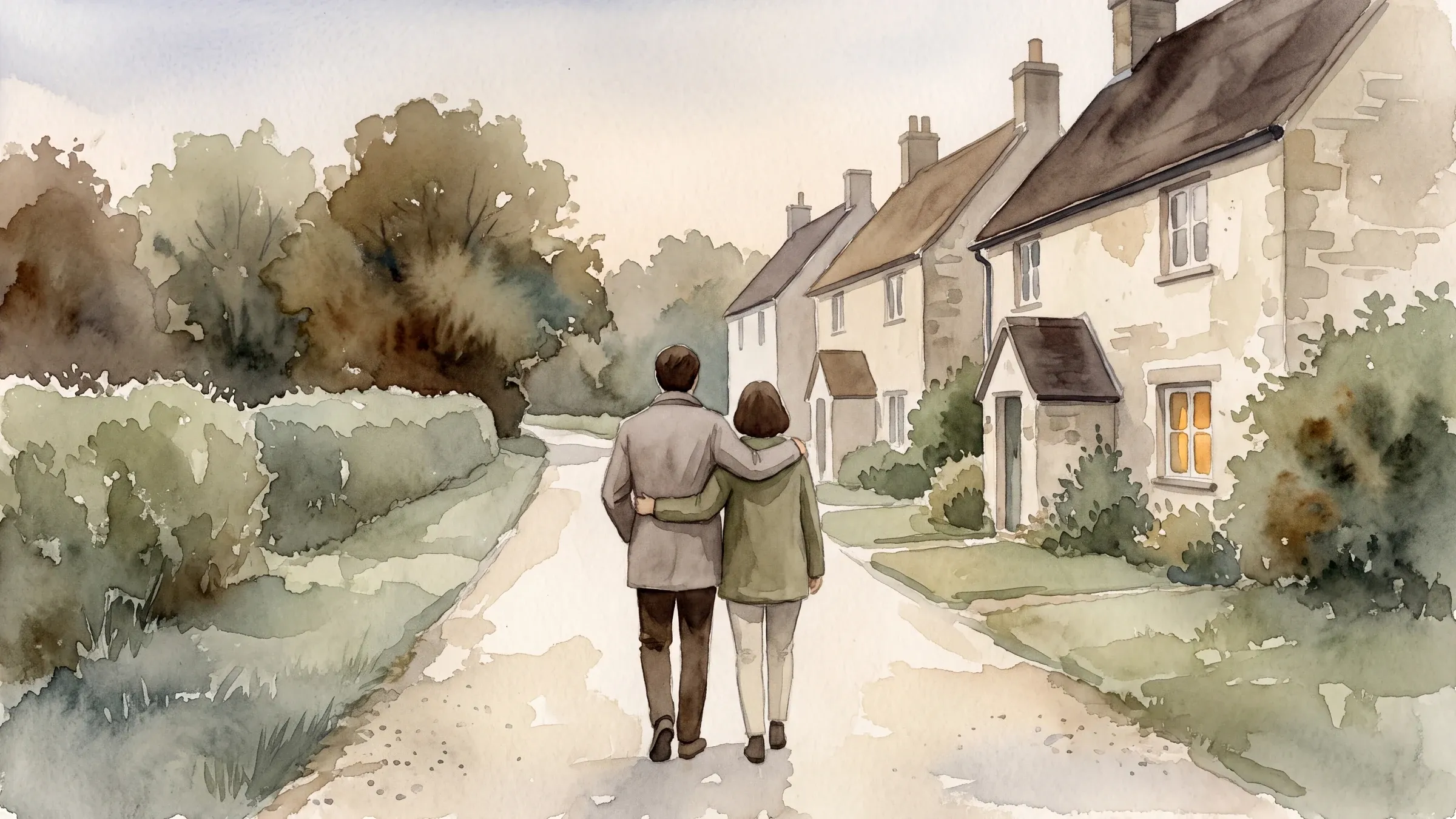
Take Ellie and Tom, who started a loop round their estate after dinner last January mostly to get out of washing up. It takes them 14 minutes. Nine months on, it’s the one part of the day neither of them skips, partly because the dishes still need doing when they get back, and mostly because it’s the only time they talk without a screen in the room.
Does walking after eating help digestion?
Partly. A slow post-meal walk made the stomach empty faster in a 2008 study: 107 minutes versus 123. But it didn’t change how full or uncomfortable people felt. Faster emptying is real; symptom relief wasn’t shown.
That study, by Franke and colleagues at Heidelberg University’s Mannheim hospital and published in the Journal of Gastrointestinal and Liver Diseases, tested 10 healthy men after a solid meal. Some drank a digestif (brandy, herbal liqueur, aquavit), some an espresso, some water, and one condition was a slow walk at 4 km/h.
Only the walk changed anything. Gastric half-emptying time dropped from 123 to 107 minutes. The digestifs and the espresso did nothing, which is worth knowing next time someone orders a grappa “for digestion.” But the participants’ reported discomfort was unchanged in every condition, including the walk.
So the honest version: a walk moves things along. Whether that makes you feel better is less settled than the wellness articles suggest.
Is it bad to walk right after eating?
Not at a gentle pace. A slow stroll is what the studies above used, at 4 km/h or about 3 METs. Discomfort is more likely with brisk walking or running on a very full stomach. If you get a stitch, slow down, and save hard exercise for later.
There’s a sensible scale here. A stroll right after eating is fine for most people and is what the research supports. A run straight after a large meal is a different thing, and plenty of people find it unpleasant. Pace is the dial, not the clock. If a particular meal leaves you uncomfortable whenever you move, that’s worth mentioning to a doctor rather than pushing through.
Why is the after-dinner walk easier with someone else?
Because dinner is the meal you’re most likely to share. The walk that does the most for blood sugar is also the one with a built-in companion, and a walk with someone in it is much harder to skip than one you planned alone.
This is the part the health studies don’t measure, but it’s the part that decides whether you actually do it. A 10-minute post-meal walk is trivially easy once. The hard part is the 40th time, on a cold Tuesday in November. Research on walking with others, which we covered in the benefits of walking with friends, consistently finds that company makes walking stick better than intention does.
It also works at a distance. Priya and her brother Sam live two time zones apart and eat dinner at roughly the same local hour. Since the spring, whoever finishes first starts a walk in Steps Club, and the other one sees it and heads out too. They aren’t on the phone. They just know the other one is out there, walking off the same sort of evening.
That’s what Live Walking Sessions are for: when you start a walk, your club sees you’re out, and if they’re walking too you see each other side by side. Steps Club doesn’t read your blood sugar, time walks to meals, or send dinner reminders. It just makes the walk visible to a few people you chose. For couples who share the table, our guide to the walking app for couples goes further into the after-dinner ritual.
How do you make walking after eating a habit?
Attach it to the end of the meal itself. Clearing the table is the cue, and the walk is the next thing. Habit research favours specific triggers over vague goals, and dinner is already the most reliable fixed point in most people’s day.
This is a classic habit stack: an existing behaviour followed by the new one. Our guide to walking habit stacking lists after-dinner as one of the strongest anchors, and the research above explains why it’s worth the slot.
A few things that make it stick:
- Keep shoes by the door, not in a cupboard. Friction kills small habits.
- Set a floor, not a target. “Round the block” is enough. Ten minutes is the goal, not the minimum.
- Have a rainy-day version. Five minutes of walking around the house, or up and down the stairs, keeps the chain going.
- Don’t make it a workout. It’s a stroll. If it becomes training, it becomes something you skip.
If you want the bigger structure around it, building a walking routine that holds up covers the rest of the week. And if you’ve noticed that small, scattered movement seems to matter more than it should, our piece on NEAT exercise explains why.
What to take from this
Walking after eating is one of the rare health habits where the research is consistent, the cost is tiny, and the timing advice is specific.
- Post-meal walking lowers the blood sugar rise after a meal. Pre-meal exercise doesn’t, per a 2023 meta-analysis of 8 trials.
- Sooner is better. The benefit is strongest when you start as soon as possible after eating. Wait for comfort, not for the clock.
- Ten to fifteen minutes at an easy pace is what the main trials used. Shorter light walking still beats sitting.
- Dinner matters most. In one trial, the post-dinner walk cut the glucose rise by about 22%.
- Digestion claims are half true. Walking empties the stomach faster, but didn’t change how people felt.
- Company makes it last. The meal that needs the walk most is the one you’re most likely to share.
The best version of this is unremarkable: a loop round the block after dinner that nobody thinks of as exercise, with someone you’d have spent the evening with anyway.
Find your after-dinner people. Get Steps Club on the App Store or on Google Play. Two clubs and five friends are free, and the next time you head out after dinner, the people in your club will know you’re walking.